As part of my initial assessment process at work, I get to ask the kids a bunch of questions that create a chance to really get to know them. One important question that helps break the ice with them is asking, “Tell me about something you’ve done in the past that you are proud of.” That can be a really tough question for them; they often haven’t received praise for a lot in their life, even when they should have.
As I’ve gotten more comfortable with who I am as I age, I recognize a lot of things I’ve done in my past that I feel were real achievements. Most of them are related to my family, the center of my life. There is one, though, that is ridiculous, but an achievement nonetheless:
I survived as a diehard Buffalo Sabres fan throughout the longest period without a franchise making a single trip to the playoffs in NHL history.
Of course, qualifying for the Stanley Cup Playoffs is a lot harder today than it may have ever been in NHL history. In the 1980s, for example, 16 teams qualified for the playoffs in a 21-team league. Today, there are still 16 playoff berths, but now, there are 32 teams in the league. That takes the percentage of teams in the playoffs from 76% back then to 50% now.
Still, you’d expect a team to find their way in at some point over a 14-year window. The previous longest playoff drought in NHL history belonged to the Carolina Hurricanes, who missed for nine years in a row between 2010-2018; the Sabres blew way past that with flair.
Luckily, it’s finally over.
At this time, in the spirit of a clinical social worker, I’d like to share my trauma narrative from dealing with this.
2011-2012
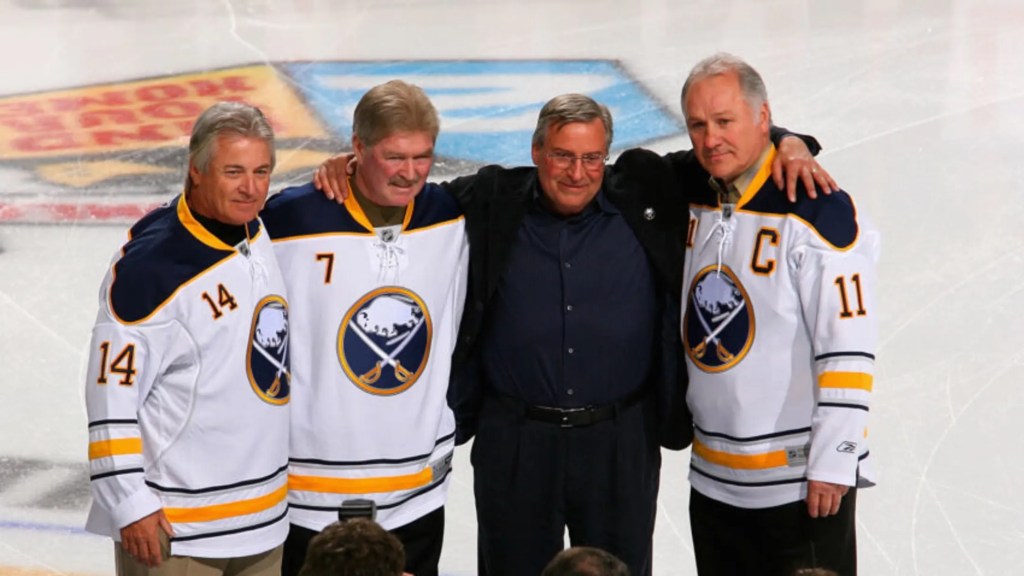
The Sabres were bought by Terry Pegula on February 22, 2011. There was a ton of hope that he brought along; he had deep pockets and loudly exclaimed that money would no longer be a constraint on building a winner. The previous owner, Tom Golisano, was a billionaire in his own right, but ran the team on a budget where he was focused on not losing money; the transition to Pegula, a huge fan of the Sabres before buying the franchise, led to hopes of a different approach to hockey. The team was somewhat mediocre that year; however, the change in ownership seemed to energize the team. They closed the season on a 16-4-4 run and snuck into the playoffs.
To give you an idea of what sort of fan I am, Kim and I went on a trip to visit Civil War battlefields as part of a class she was taking to finish up her bachelor’s degree. The battlefields were Manassas (Virginia), Antietam (Maryland), and Gettysburg (Pennsylvania). Obviously, they were far out of range of any Sabres radio broadcast. I got around missing Game 2 while out on the battlefield in Maryland by calling in the Mix 101.5 and having them put me on hold so that I could listen to the game by cell. It was a back-and-forth game, with the Sabres losing 5-4; the series ended with the Flyers blowing out the Sabres in Game 7.
It was their second straight first-round exit, but with an infusion of money, it felt like the Sabres were headed places. Sure enough, Pegula made it clear that they were going to be aggressive in the free-agent market over the summer, something they had never really done in the history of the franchise.
The major free-agent prize that offseason was Brad Richards, a 31-year-old center for the Dallas Stars at the time; he was coming off a 77-point season, and was seen as a key piece on the 2004 Stanley Cup winners in Tampa Bay. The Sabres were rumored to be in heavy pursuit of him; that was confirmed by Terry’s daughter Jessie (now the 5th-ranked tennis player on the planet), when she tweeted out “So no Richards” before quickly deleting it. She probably meant to text a family member (Terry is notorious for carrying a flip phone, so who knows if it was him), but the message was clear – we were not getting him. He ended up signing with the New York Rangers, had one good season, and ended up tailing off quickly afterwards, which suggests that maybe it wasn’t a huge loss.
The Sabres were able to go out and get defenseman Christian Ehrhoff and forward Ville Leino in free agency; it was rumored that Pegula was keenly interested in both. They also put in a ton of effort to get journeyman defenseman Robyn Regehr to waive his no-trade clause to leave Calgary for Buffalo.
The season started off well, with two wins over the Los Angeles Kings and Anaheim Ducks over in Europe as part of a 10-5-0 start.
Their next game broke the team for a long time.
On November 12th, the Sabres were playing the Bruins in Boston. During a play in the first period, with Buffalo leading 1-0, Sabres star goalie Ryan Miller was playing the puck outside of the crease on a puck that had gotten away from Bruins forward Milan Lucic. It was a play common in the NHL, and most people understood that checking the goalie in that situation was crossing a line; however, Lucic was always willing to cross a line, and absolutely leveled Miller.
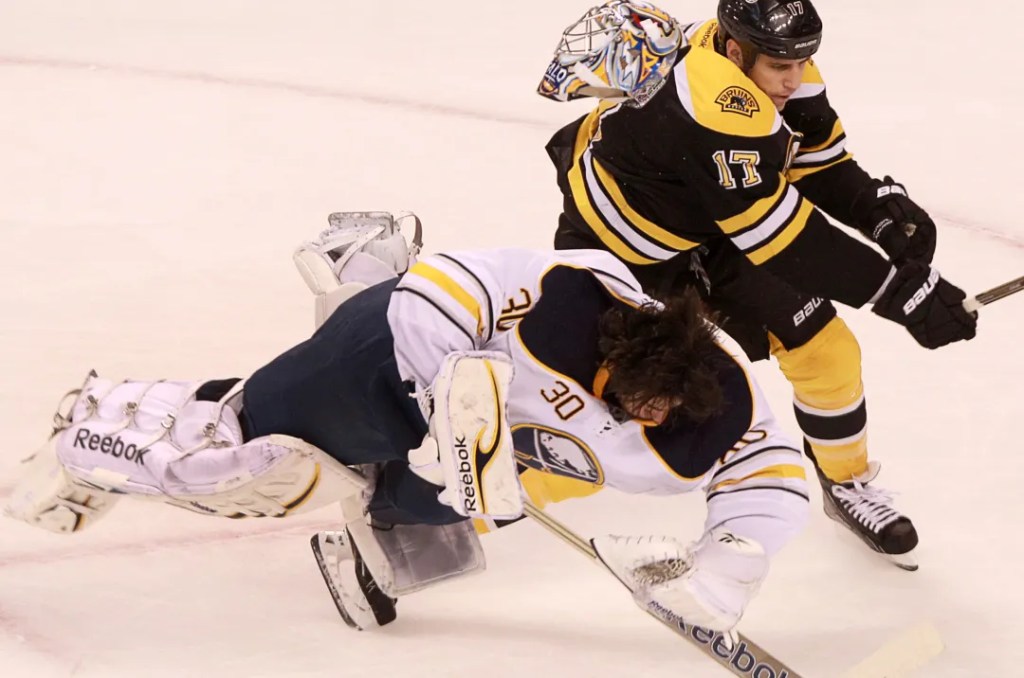
As you can see, he hit Miller so hard that the goalie’s helmet flew off.
Usually, this would lead to a brawl led by the Sabres on-ice; instead, the response from the team was to push Lucic against the wall and nothing else.
Lucic didn’t get fined or suspended for the hit; he didn’t even get a penalty on the play. The league sent out a memo to teams afterward saying that would not be allowed again, but that does nothing to suggest he did something wrong in that moment.
I was watching that game; it was clear immediately that this was going to be a problem long-term in terms of team morale.
The team gave up the next six goals and lost 6-2 that night. Immediately, they were labeled soft, and rightfully so; they let their best player get hit while defenseless and didn’t respond.
Miller missed the next nine games with a concussion; the team went into a tailspin, going 9-19-5 over the next 33 game stretch, including a then-franchise-record 12-game losing streak. They had a better stretch before the end of the season; however, they did fall three points short of a playoff berth.
The free agents were a mixed bag. Ehrhoff had a decent season, and Regehr was solid if not spectacular; meanwhile, Leino had 25 points in 71 games, less than half of what he scored the season before.
2012-13
The owners did Sabres fans a solid one by locking out the players just before the start of training camps in September to help figure out the Collective Bargaining Agreement between the two sides. The season didn’t start until January 20th, 2013.
The Sabres started off slow, and fans began calling for coach Lindy Ruff’s head. In his first decade with the Sabres, he had led the Sabres to four conference finals and a Stanley Cup finals appearance; however, it seemed as if the team had become disinterested in playing for him.
Sometimes, in sports, you don’t change coaches because you believe you’ve found one that is clearly superior to anyone else available; instead, you figure that you need a different voice in the room to handle the team differently, hoping they’ll respond. The Sabres did just that, firing Ruff; however, they bungled the other part by bringing in a coach that appeared to be outmatched in the Rochester Americans’ head coach, Ron Rolston, as his replacement. The Sabres were out of the running pretty early, and finished seven points out of the playoffs.
The negatives went beyond just the record.
- The Sabres had 18-year-old Mikhail Grigorenko, the 12th pick in the 2012 draft, stay with the team for the first half of the season rather than returning to juniors because of a lack of forward depth, particularly at center. He was completely overmatched, and put up five points in 25 games before being sent back to juniors midway through the season. He may never have been a legitimate NHL player, but he never looked capable after being rushed up this early.
- They began disassembling the team they had, trading away one of the great Sabres of the previous decade, Jason Pominville, to the Minnesota Wild for center Johan Larsson, goalie Matt Hackett, a 2013 1st-round pick, and a 2014 2nd-round pick. They made two other deadline deals, as well, picking up a 2nd-round pick in each of the next three years. (This is going to be a theme going forward.)
- They found a way to go 8-4-0 in the final month; this moved them down to selecting 8th in the 2013 NHL Draft. If they had gone 4-8-0 instead, they would have been picking 3rd.
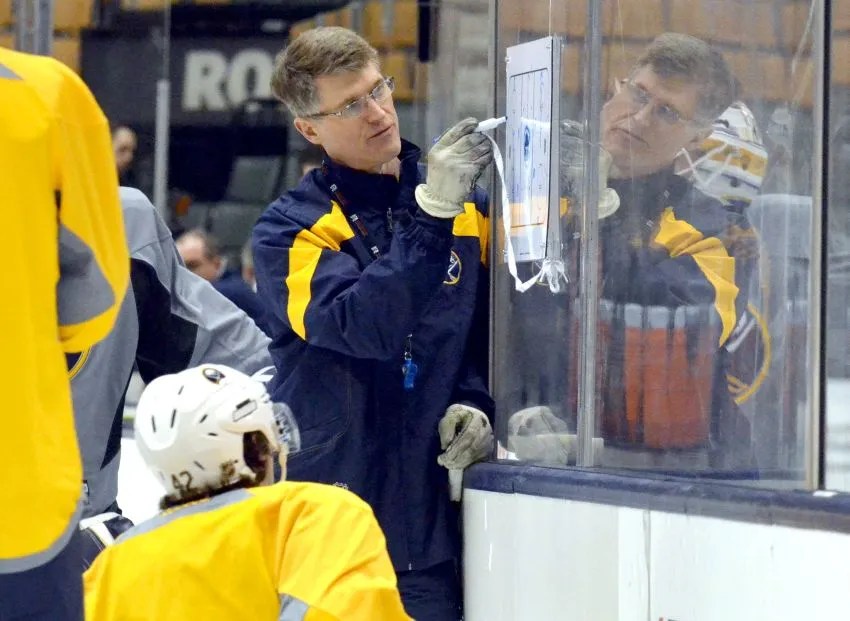
- Everyone found out that Rolston would wear gardening gloves for practice rather than hockey gloves, saying that they were easier to write on the chalkboard. He has never lived this down.
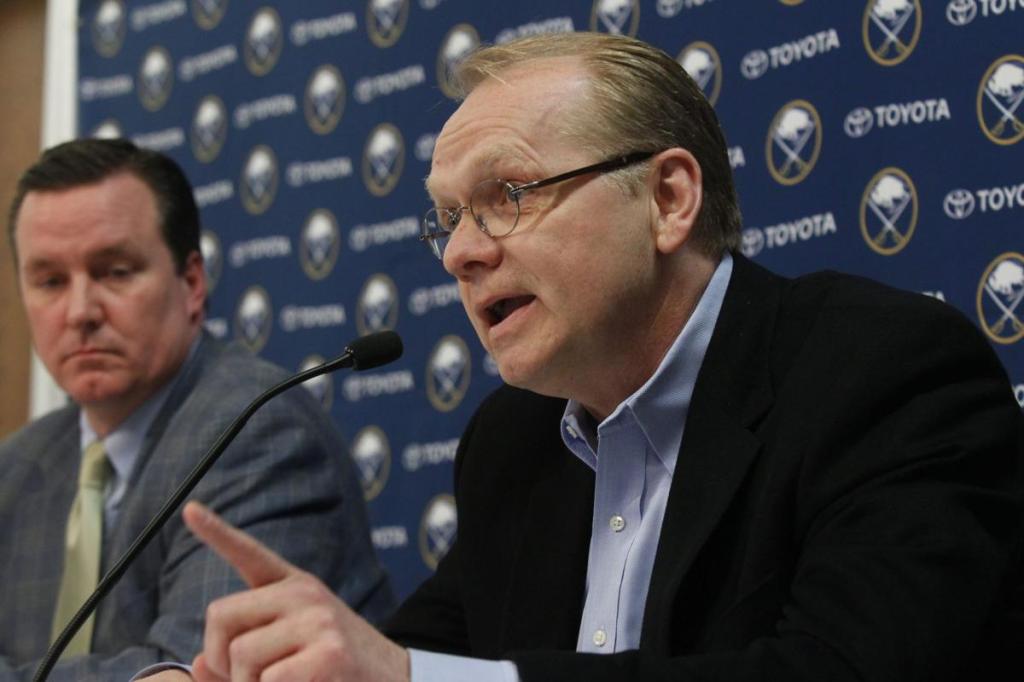
- General Manager Darcy Regier announced at the end-of-season press conference on April 30th that the team and its fans may endure some “suffering” before success returned. Unfortunately, that was a severe understatement.
There were a couple of positives, I’m sure; Kim and I might have gone to a game or something. I just don’t remember getting very fired up.
2013-14
In September, the Pegulas cemented themselves as a beloved family in Western New York; they outbid Donald Trump and a group of investors including the owners of the Toronto Maple Leafs and Jon Bon Jovi to purchase the Bills. (If you ever want to go down a fun rabbit hole, look up the story of Trump, the Bon Jovi investor group, and the bidding for the Bills – it is an adventure.) Their purchase seemed to guarantee that the Bills were going to remain in Buffalo. (There’s another fun rabbit hole to travel down, especially if you throw “Austin”, “Andrew Cuomo”, and “Kathy Hochul” in the search bar with it.)
The offseason was totally unremarkable on the Sabres’ end of the Pegula empire. The season was not.
- The preseason featured a line brawl with the Toronto Maple Leafs which led to Rolston being fined for “player selection”.
- On October 27th, they traded away another star from the past decade, Thomas Vanek. Vanek was often derided as being soft, inconsistent, and overpaid. Personally, I liked Vanek’s play; he had two 40-goal seasons and another two 30-goal seasons during his eight full seasons in Buffalo, with one of the lower-scoring seasons being the previous season that featured only 48 games. He was never a power forward, nor did he ever present that he was; what he did provide was plenty of scoring, something the team lacked during his later years with the team. He was sent to the New York Islanders for Matt Moulson, a 1st-round draft pick, and a 2nd-round draft pick.
- They started the season with four teenagers in the lineup, including their two 1st-round picks from 2012, Grigorenko and forward Zemgus Girgensons, and their two 1st-rounders from the summer’s draft, defensemen Rasmus Ristolainen and Nikita Zadorov; the four found out what “suffering” could be, as the team jumped out to a 3-15-1 start.
- The Sabres had to find unorthodox ways to score, as they lacked a ton of offensive talent. One interesting tactic used was the infamous “Butt Goal” on December 23rd, where rookie Mark Pysyk scored the winning goal in a 2-1 overtime game against the Arizona Coyotes, another team trying to find their way to the bottom of the league standings. Pysyk’s shot from the blue line deflected high into the air; it landed in the back of Coyote goalie Matt Smith’s pants, and he drifted back into the net with the puck lodged there. Because he slid back into the net, it was a good goal.
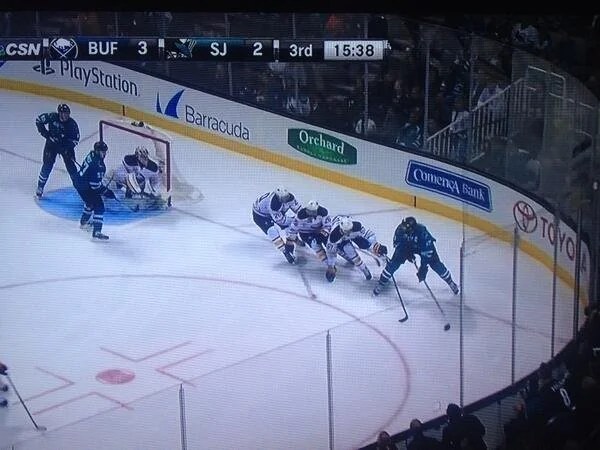
- Most importantly, we saw the birth of the Sabres Centipede.
On November 13th, the Sabres fired Regier after 16 years as GM, and Rolston was shown the door as well. With great fanfare, the Sabres brought back former superstar Pat LaFontaine to be the President of Hockey Operations, and his coach from his playing days, Ted Nolan, as the head coach.
This was the beginning of “The Tank”. Unfortunately, no one told the new hires that this was the plan.
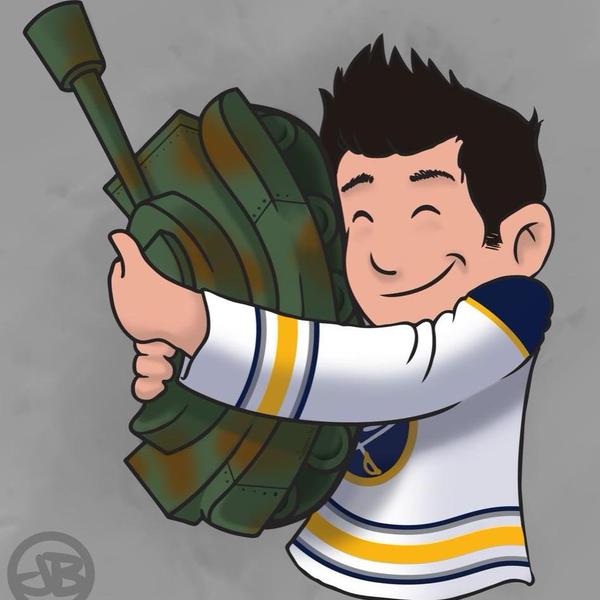
Tanking was something that many North American sports fans had always suggested was a good idea; after all, the worse your record is, the higher your draft pick ends up being. The best players are usually the top picks in a given draft, especially in hockey, where the superstars are consistently picked in the Top 5. It’s rare that a superstar in the NHL hits free agency; either you draft them or trade for them. No team ever really let on that this was a clear strategy; it’s basically admitting that you’re not going to be competitive, which is not something that sells tickets.
The Sabres clearly embraced tanking. Even though they played somewhat better over the next three months, it was clear the team was going nowhere for a while; during that period, they hired Tim Murray to be General Manager. Murray came from a family of hockey executives and had two decades of experience as a scout and team executive, but this was his first job running a team’s hockey department. He was highly regarded in NHL circles. He had a much different vision for the team than LaFontaine, though; he wanted to clear everything worthwhile off the books, while LaFontaine wanted to try and retain as much talent as possible and retool. Murray’s vision was supported by Pegula. LaFontaine abruptly resigned from his job on March 1st, and has had nothing to do with the franchise he once starred for since.
The fire sale started by trading superstar goalie Ryan Miller and team captain Steve Ott to St. Louis on February 28th, which likely was the final straw for LaFontaine. They dealt Moulson and the goalie they got in return from the Ryan Miller trade at the trade deadline a week later. They also traded away young defenseman Brayden McNabb along with two second-round draft picks in exchange for forwards Hudson Fasching and Nic Delauriers; Delauriers provided 12 goals for the Sabres over 211 games, while Fasching would eventually help to extend the drought. McNabb, meanwhile, is currently approaching 900 NHL games, has been a consistent contributor on the ice, and won a Stanley Cup with the Vegas Golden Knights in 2023.
With all the trades over the season, they accumulated seven draft picks; three would become NHL players, two that starred elsewhere without ever playing in a Buffalo uniform, and the third playing a total of 23 games for the Sabres (defenseman Brendan Guhle, who never became a full-time NHLer). Best of all, with a 2nd-round pick 2014 draft pick from Minnesota, they drafted Vitek Vanecek, who would eventually turn into a goalie who saved his best play for facing Buffalo.
They traded a conditional 6th-round pick to Edmonton for Linus Omark, who had two assists for the Sabres in 13 games that season. The Sabres tried to send him to their minor league affiliate in Rochester; he refused, had his contract terminated by the team, and went back to Europe and spent the rest of his playing career there.
They played six goalies in all that season; anyone that made more than 10 consecutive saves in a game was immediately traded. They ended up with 52 points, finishing 14 points behind anyone else in the league.
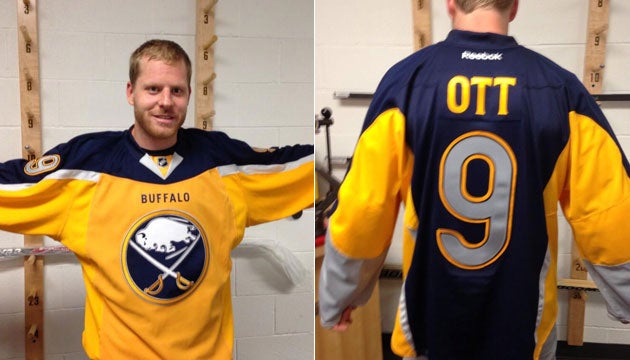
These pale in comparison to what may have been the worst look of the drought.
This thing debuted as their alternate jersey that season. Arguably the ugliest thing ever worn by any mammal.
2014-15
Regardless of where you stood on tanking, this season was the first ultimate low in the history of the franchise.
The two major free-agent pickups at the beginning of the drought, Leino and Ehrhoff, were bought out as part of a salary compliance opportunity after 2012-13 lockout. Leino had managed to not score a single goal in 58 games the previous season; after his hockey playing days, he admitted in the Buffalo News that he hated his time in Buffalo. (The fans had a mutual take on his play.) Ehrhoff had been decent at his price point of $4,000,000 per year, but with seven years remaining on his contract, he was likely to be an albatross on the cap in the future, especially with rules from the most recent Collective Bargaining Agreement between the owners and players that created huge salary cap recapture penalties for contracts with years the end of them that served the purpose of lowering the cap number but were never intended to be used.
The draft was somewhat helpful. They lost the draft lottery to the Florida Panthers, who had the second-best odds; with the #2 pick, they picked forward Sam Reinhart, who was considered one of the four blue-chip prospects in the draft. They also picked Victor Olofsson in the 7th round, where picks rarely materialize; he would actually become a significant player, unlike the rest of their picks in that draft.
They actually did some useful things in free agency as well. They added Rochester native, Stanley Cup champion, and former Montreal Canadien captain Brian Gionta on a three-year deal and named him the new captain, with the goal of him being the leader once the franchise decided to start trying to win again in the near future. They also brought back Matt Moulson on a 5-year, $25,000,000 deal. They even traded for defenseman Josh Gorges, who they promptly put on the top defensive pair with Ristolainen. There were a couple other additions, but no one signed with the intention of making a difference on the ice.
The Sabres had one major problem: they needed to get to the NHL’s salary floor. Not only is there a maximum amount you can pay your team over the course of the season, but there is also a minimum. The Sabres were at only about $38,000,000 after making any useful free agent signings; the salary floor was $51,000,000. They fixed their problem by adding $11,000,000 in cap figures belonging to players who were physically unable to play in the NHL any more, and another $4,125,000 on defensemen Andrej Meszaros, who probably would have gotten the league minimum anywhere else.
I took a peek at the Wikipedia article that was meant to give an overview of the season; there was no write-up on anything involving the actual play in the regular season, just a mention of the Prospects Challenge game in July that attracted over 8,000 people. Somehow, they still sold 97.4% of the seats in the arena over the course of the season, even though the seating bowl was frequently sparsely populated.
The tanking was vicious. Ted Nolan is a beloved figure in Sabres history; he was considered a blue-collar coach that preached effort, and he was revered for putting a team with Dominik Hasek and 18 warm bodies on the ice in 199-97 and finding the way to the second round of the playoffs. The analytics, though, suggested he was the least effective coach in the league. The goalies were below-replacement-level, and the roster was somehow even worse than that, even though it technically is impossible. He did manage to get a consistent effort out of the guys on the ice, sometimes using interesting motivational tactics like this:
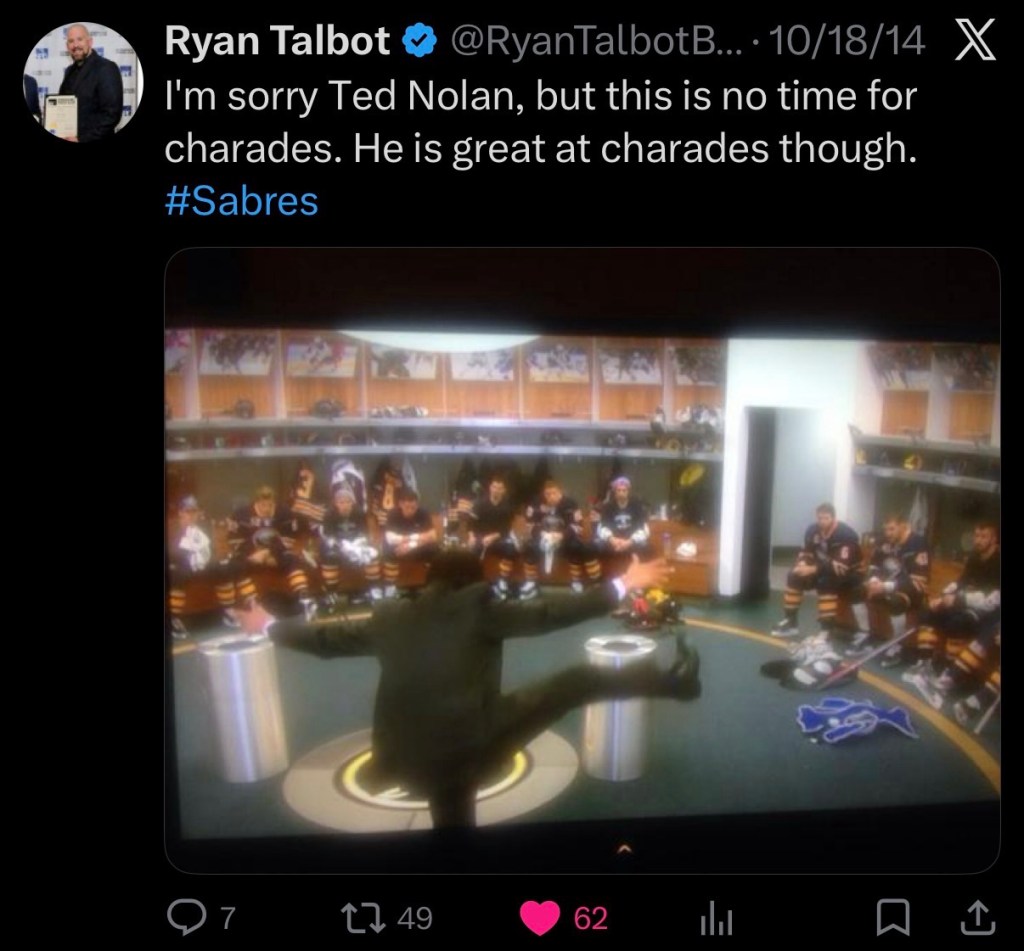
This demonstration helped rally them to a 4-0 loss to the Bruins.
Reinhart started the year in the NHL, but it was clear he was not quite ready for the league; this time, the team made the right decision and returned him to junior hockey before they burnt the first year on his entry-level contract.
The Sabres continued to set franchise records, this time managing a 14-game losing streak, including failing to collect as much as a loser point in the entire month of January.
One highlight of the season was a career season for second-year center Zemgus Girgensons. The “Latvian Locomotive” became a sensation in his homeland, as a rap artist wrote a song about him, and the nation hopped behind his style of play. The citizens flooded the website to vote on players for the NHL All-Star Game, and Girgensons was the leading vote-getter in the entire league. Girgensons only got to play in 61 games, but he set career highs with 15 goals and 30 points. (Realistically, that is him topping out, talent-wise. He’s a great effort player, but was never meant to be a scoring forward.)
The Sabres actually began to build towards the future as the trade deadline approached, but in a way that would not jeopardize the tanking plan. They traded with the Winnipeg Jets for forward Evander Kane, defenseman Zach Bogosian, and throw-in goaltender Jason Kasdorf. The Sabres gave up defenseman Tyler Myers, forward Drew Stafford, prospects Joel Armia and Brendan Lemieux, and a first-round pick that ended up being Jack Roslovic, who has been a journeyman forward but has still racked up nearly 600 NHL games. Kane, the prize for the Sabres in the deal, was already out for the season, having just undergone shoulder surgery, which it seems he decided to pursue after being a healthy scratch by the team the week before because the entire team was fed up with his antics. (That should have been a red flag, and it will eventually become evident.) However, the trade deadline was business as usual, making trades for a total of five draft picks, none of them set to occur in the 2015 NHL Draft.
The lowest point ever on the ice for the franchise was the March 26th game at home against the Coyotes. The Coyotes were the Sabres primary competition in the race-to-the-bottom of the league standings. Sabres fans actively cheered against the team that night; the Coyotes eventually won 4-3 in overtime, and the fans literally rejoiced. Sabres defenseman Mike Weber was livid about the fans’ reactions, using terms such as “a new low”, “disgraceful”, and “extremely frustrating”. Even if you were behind the tanking concept, the look was very poor.
The Sabres clinched the worst record in the league with a 4-2 loss in Columbus on April 10th. The tank officially accomplished its initial goal.
The next step: eventually coming out of it as a winner.
Part 2: The Drought, 2015-21. https://tompowerproject.com/2026/04/17/the-drought-part-2-2015-2021/


Leave a Reply