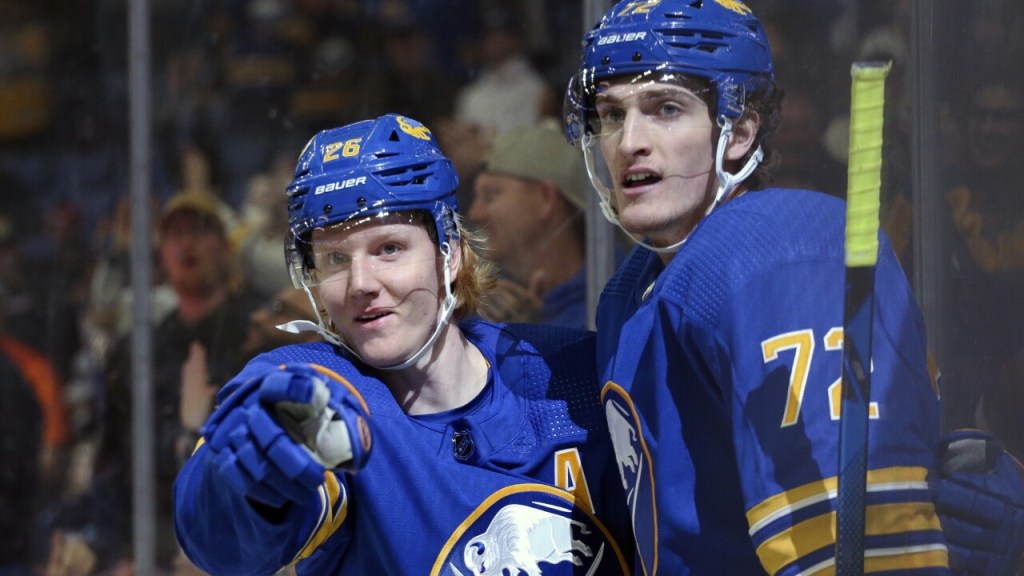
We’ve deserved this.
If you haven’t gone through my three-part dissertation that I’ve used to cleanse myself of the drought, it comes down to two segments. The first ten years involved the creation of a hostile work environment where management decides to find a way to only make things worse. The last five years has been a purge of those mistakes and a rebuild of both talent and interest for all involved.
Most humans love sports. The sport of choice differs throughout the world, but the thrill of competition is something that is universal. Whether we’re the ones playing, watching our loved ones play, or sitting in the crowd watching a bunch of strangers go at it, we are compelled to take it in and appreciate the various aspects of sport. The strategy, the energy, the feats that create the competition, and the subplots – they make for a compelling story.
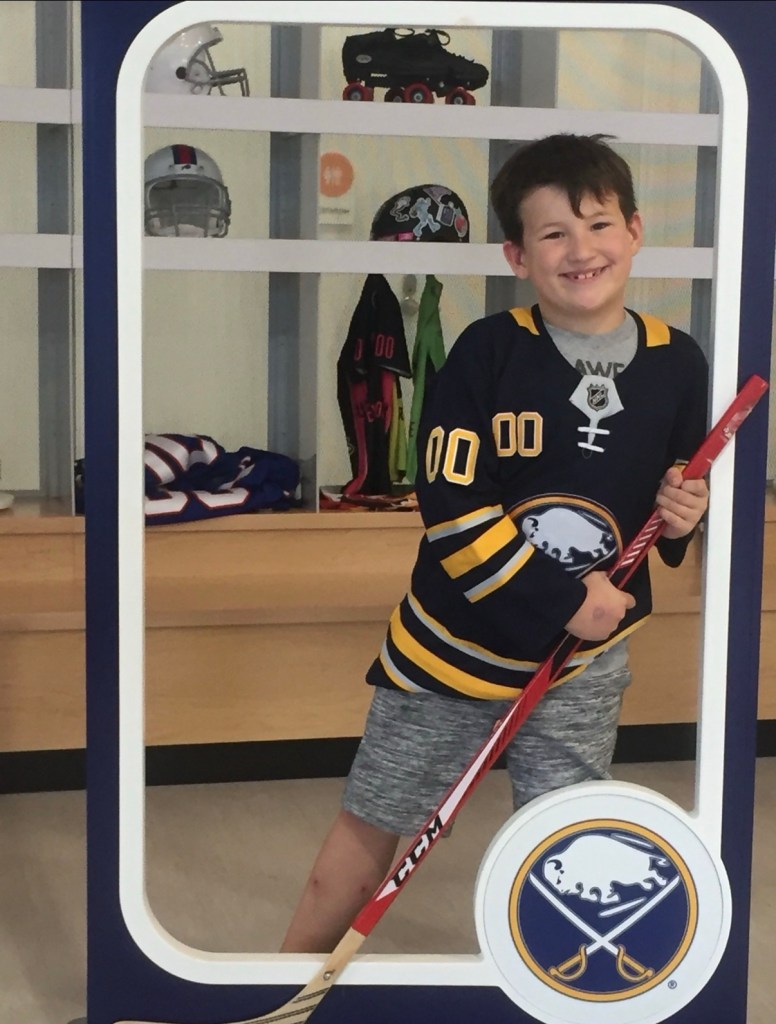
Not everyone is big on sports, of course. My son Ben has little interest in watching them. The Sabres are the exception. (That’s him above at Explore & More at Canalside, 7 years old at the time.) He’ll sit and watch parts of games with me, which is more than just a moment of father-son bonding; if that were the case, I’d see him on Sundays between September and mid-January when the Bills are on. He genuinely enjoys watching hockey. For his 14th birthday this year, the request wasn’t for having a couple of friends sleep over, a big present, or some sort of celebration – it was a weekend in Buffalo centered around attending a Sabres game.
He was born January 5th, 2012, three months into the first season of the drought. They were 18-17-4, in 11th place in the conference, and four points out of a playoff spot; they’d finish three points out that season. I’ve detailed the story since using 40,000 words. It hasn’t stopped him from enjoying the Sabres.
If you’ve been to a game in-person, you’d definitely get it. Hockey is best enjoyed when you’re in the arena. You get to appreciate the speed of the game and the difficulty of the feats that look effortless to them. The sheet of ice makes the air crisp yet not overwhelmingly cold, like it gets outside of Key Bank Center during those winter months.
There is a much different energy in the experience of the Sabres game than that of going to see the Bills. The game is the reason everyone gathers there, but far from all that it’s about. We love the Bills, no question; it’s the most identifiable thing about Western New York.
Remember, though, that the Bills Mafia phenomenon really got going in the middle of their 17-season playoff drought. I’d go to games in the early 2010s, and the most common jersey I’d see in the parking lot was that of Brian Moorman, the punter. If fans are at the point that they choose to buy the punter’s jersey just to have one to wear, your team is in a bad spot. However, that seemed to only fuel the fanbase; the party was why people would flock to games, even though they knew the team was on their annual heroic march to 7-9 and the 12th pick in that spring’s draft. That’s continued since the team has become a legitimate contender, and even intensified in some ways; alcohol does that. I’ve have had friends on 20A waiting in traffic at 8 AM in the morning, and watched two middle-aged people (one male, one female) in the back seat of the car in front of them step out of the car on opposite sides, puke, and then hop back in nonchalantly., probably starting their rally with another libation. In 2023, the Erie County Sheriff’s Office announced that 10 people sacrificed themselves to “The Pit” created when the new stadium was undergoing its initial construction; the self-sacrifice was made in hopes of getting the Bills a championship.
The Sabres experience is much different. The building is obviously smaller and enclosed, and there is no seat that’s very far from the ice. There are fewer fans drunk out of their minds because many games are on weeknights. The action is constant, the play changes and evolves in seconds, and the anticipatory buzz when a big play seems imminent is thrilling in itself. And if things go poorly on a given night, there will be another game in two or three days, which makes it a little easier to shrug it off.
This season started out looking like another dud. For instance, take this retweet I posted, and note the timestamp:
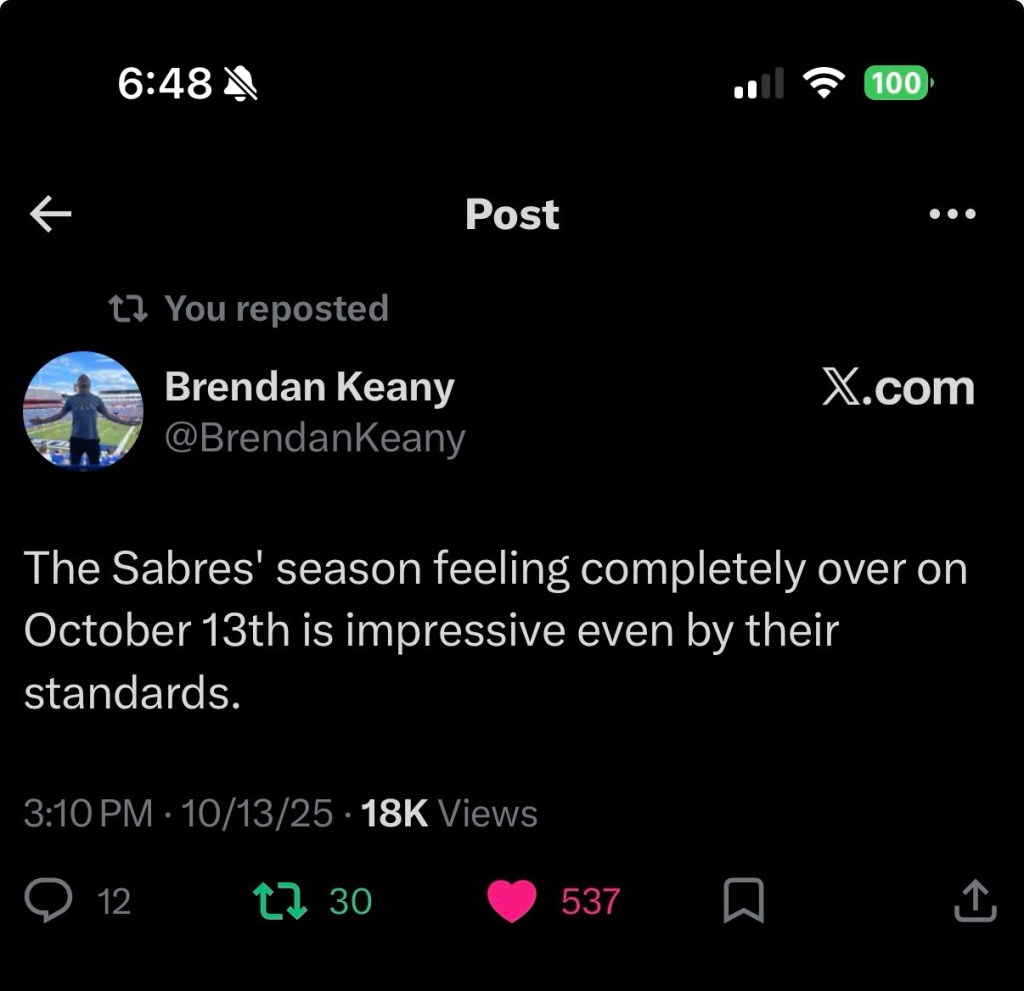
This was moments after the Sabres dropped a 3-1 decision to the Colorado Avalanche in an afternoon home tilt on Columbus / Indigenous People’s / Italian-American Heritage Day (pick your own name for it). There’s no shame in losing to the Avalanche; they’re the odds-on favorite to win it all this year. However, the Sabres looked like a mess; they’d been outscored 10-2 in their three losses to that point, and those games never really felt competitive.
Of course, everyone knew the season wasn’t over; the fanbase had just reached the point where expectations were minimal, at best. Calling it a year would have been the equivalent of giving up the Bills at halftime of Week 1 in 2019 against the Jets, a half when Josh Allen had two interceptions and lost two fumbles. As we all know, they won that game, finished 10-6 that year and started their run of seven consecutive playoff berths.
The first two months seemed to be the annual fade from contention. On December 8th, they had the third-worst record in the league and were already eight points out of a playoff spot. Teams rarely recover from that.
The team was in the middle of a six-game road trip that started in Philadelphia, then went west, having the team travel to see the four Canadian Western Conference teams and finish in Seattle. Those trips are where the players are without family and the comforts of home; they are rough, I’m sure, but there ends up being a lot of team bonding during that time. The team already acknowledged that they all got along; the bonding this time came in the form of looking at each other and agreeing that they were going to go all-out to end the drought.
The switch flipped. They ripped off ten straight wins, then built on it with a 11-5-1 run between New Years’ and the Olympic break on February 5th. At that point, they were in the first wild card position, with a four-point lead on the first two teams out of the playoff picture.
There was a lot of concern about the Olympic break. When teams are in rhythm, you don’t want it disturbed; that is easy to happen when you go 20 days between games. The Sabres managed to avoid that. They responded winning 12 of 13 out of the Olympic break. They were now leading the division and 10 points clear of the first team out of the playoffs with 12 games left in the regular season.
The March 8th home game against the Tampa Bay Lightning was legendary. Several media outlets have labeled it “the most eventful (NHL) game in decades”. It was a Sunday night, 6 PM game. The Sabres were playing the latter half of a back-to-back. The teams were tied for first place in the division. The tension and competition was palpable. There were 28 penalties and 102 penalty minutes; those were the highest numbers of those two in a game since 1993 and 1989, respectively. The Sabres came back from a two-goal deficit in the final 10 minutes to win 8-7 in regulation.
It was the moment everyone in the league recognized they were not just on a run, but for real. Of course, they didn’t need that game to make that evident to most that actually followed; that was Game 34 of a 32-6-2 run, the best 40-game run by any team in the league in three decades.
It was more than having everything fall into place at once. The team’s analytics at 5-on-5 play have been solid for the past two years. However, they were consistently having defensive issues. The big issue has always been the goaltending; average goaltending would probably have been enough to get them into the playoff field at least once in the three previous seasons.
The goaltending has been good this season. Ukko-Pekka Luukkonen (UPL) and Alex Lyon primarily split the duties, with Colton Ellis, who had been plucked off of waivers just before the season with UPL injured, providing some solid starts as well. All three goalies’ save percentage were over .900, which had been rare in the past five years.
The defensive core hit a new level this year. Colorado’s defensive unit is the class of the league; Rasmus Dahlin, Mattias Samuelsson, Bowen Byram, and Owen Power are probably as good of a top 4 defensive group you’ll find outside of Denver. Dahlin is one of the five best defensemen in the NHL. Byram provides the second pair with more offense than you find on a lot of top pairs for other teams. Power has been very good with playing out of character – he is very talented offensively, but has been willing to pivot to focusing primarily on the defensive end, and has been silently reliable.
Samuelsson has been the real surprise of the campaign. A lot of people maligned Kevyn Adams for giving him a seven-year, $30 million contract after playing just 54 NHL games. He had shown that he could find a way to stay in plays where he appeared to be beat, which is helpful when you do not have a lot of top-end speed. However, he struggled in his first two years of the contract extension, and a lot of fans and media members were suggesting the Sabres should either trade him or buy him out altogether, even with only being on the books for $4.28 million per year.
This year, Samuelsson found his next level. Defensemen usually take more time to develop than forwards, and often come into their peak around their age-25 year; Samuelsson and Dahlin, who have been dominant in that top pair, are both in their age-26 season. Best of all, Samuelsson has another four years under contract; even if he does not replicate the offense he has shown this season, that contract is of great value.
The offense has been consistently excellent. They averaged 3.51 goals per game, third-best in the league. Since the run started in early December, they have not been shut out. Tage Thompson had his third 40-goal season in four years. Dahlin was nearly a point-per-game scorer from the back end. Alex Tuch was a force, as usual. Zach Benson, turning 21 in May, is a pest in the best way, and is due to pop offensively in the next couple of years. The team rolled three scoring lines, and even the fourth line, led by Beck Malenstyn, was menacing.
The team was able to manage getting only 44 games from center Josh Norris and 12 games from center Jiri Kulich. Norris is injury-prone but is dynamic when he is on the ice; Kulich was expected to show growth after 15 goals in his first full NHL season. Fortunately, others stepped in.
Josh Doan was brought in because JJ Peterka was done in Buffalo. Peterka had just finished his three-year entry-level contract, meaning he was four years away from unrestricted free agency; however, he made it clear he was not going to re-sign in Buffalo. Adams followed his mantra of wanting a team with players who want to be there, so he was happy to oblige. Finding a trade partner was not going to be hard; Peterka had 55 goals in the previous two seasons, and was still under team control until 2030. Utah (now nicknamed the Mammoth) had the assets that they could offer that might entice the Sabres; they offered Doan and defenseman Michael Kesselring.
Kesselring was seen as a solid second-pair defenseman; unfortunately, he was hurt this season and was limited to just 34 games. His injury nagged, and he eventually fell out of the defensive rotation.
Doan was considered to be a third-line winger that would primarily help with physicality and defensive play. They were wrong; he was a significant upgrade on Peterka. He (25-27-52) had a few more points than Peterka (25-22-47) to add to the tools that he was expected to provide, things Peterka lacked. The Sabres locked him up for seven years and $48.65 million in January, keeping him under contract until after his age-31 season in 2033.
Noah Ostlund, a 1st-round pick in 2022, stuck in the NHL this year, and scored 29 points in 60 games – not huge numbers, but an improvement on Kulich’s play last year; he also showed he could play solid defense, which was a weakness in Kulich’s game.
Lindy Ruff had a great season coaching. A lot of people would have preferred Craig Burube when Lindy was hired back in 2024; Berube has a Stanley Cup under his belt. However, Lindy fills that “guys that want to be here” mantra of Adams. If you were to rate the four most iconic figures of the franchise that were not owners, it would be Dominik Hasek, Gilbert Perrault, Rick Jeanneret, and Lindy. He may have been relieved of his duties as head coach in 2013 and had three other jobs since then, but he has made Buffalo his home for over four decades now, and all losing his job meant was that he only could spend summers here.
Lindy’s changed his style of coaching several times over the years. In his early years in Buffalo, it involved making life easy for Hasek, who was in the middle of the best run of any goalie in the history of the sport, by slowing the pace of the game down. His teams were often small but were aggressive on the forecheck and pestered the opponents. He was known to ride the players as hard as possible. By time the 2005-06 and 2006-07 teams were around, he had shifted to an offensively-aggressive style that flew up and down the ice. He had to adjust again for the teams later in his tenure; he mellowed a little (not totally) because he figured out that modern players had learned to tune out guys that were relentlessly after them.
I think people were worried he had lost his fastball by the time of his return; his first season as a head coach was 1997-98. The game has not only changed multiple times; the players are paid much better and have a lot more control of the team’s approach.
They forget – he was a Jack Adams Award finalist in 2022-23 in New Jersey. That was not a fluke. There was a bunch of talent on the Devils that year, but winning also requires pushing the right buttons to get them to execute.
Lindy had a gameplan for getting this team back to the postseason. The first year was the team learning his system. This season has been reinforcing it. He has not done that alone. He has leaned heavily on Seth Appert, the rising star in the Sabres’ coaching pipeline. He had coached four years in Rochester before joining Lindy’s Buffalo staff in 2024, and unlike many of his predecessors, some prospects showed significant development there and had begun to contribute at the NHL level. Lindy has turned over a lot of the in-game work to him over his tenure; Lindy only signed his original deal with the team for two years, and his goal may be to have Appert ready when he decides he’s done behind the bench. Appert has pressed the right buttons, and the team has been able to avoid blowing late leads in most games when they have the edge late, something the franchise struggled with throughout the drought.
Lindy is at his best in playoff hockey. He has an innate skill at creating the right matchups on the ice, and has some fun tactics to fix the matchups when on the road, where the opponents get to see who the Sabres put out there before sending their squad over the boards. Lindy has always been able to exploit the other team’s weaknesses effectively throughout his coaching career. It may have seemed sentimental to bring him back, but it’s also been effective.
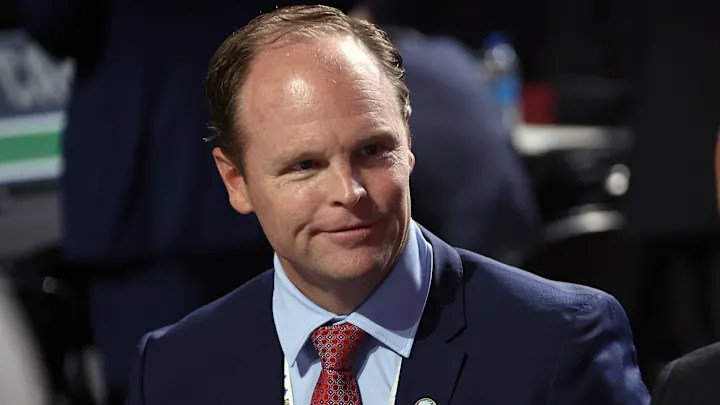
A casualty of the season was Adams. It was obvious he was headed out the door when the team hired former Columbus Blue Jackets GM Jarmo Kekalainen over the summer. Kelalainen is a known wheeler-and-dealer who found ways to bring talent into the fold and make his squad newsworthy, as hockey is an afterthought in Columbus compared to Ohio State football. Adams got fired at the end of that December road trip after five-plus seasons.
Adams was often maligned, as he was even more reluctant to make trades than former GM Darcy Regier, who often heard “Do something, Darcy!” from the Sabres fans at home games during his 16-year run as GM. That being said, Adams also converted the franchise back to respectability. The previous three GMs had created a disaster during that first decade of the drought. The first year of the drought can be seen as understandable – they missed the playoffs by three points, and a tweak or two could have easily had them return to the postseason the following year. However, Regier only had Tyler Myers, Tyler Ennis, and Marcus Foligno to offer as significant pieces from his last seven drafts, and the lack of infused talent made it hard to build on what was there. Murray didn’t just tear it down to the studs; he knocked out a load-bearing wall or two, then started hanging Picassos, hoping they’d be okay. Botterill may have been the worst of the bunch; he allowed the players to take control and do as they pleased, then doubled down by hiring a coach that couldn’t motivate and was in the wrong sport, at best.
Adams was stuck shedding star players while being expected to stay close to the salary floor for years. If you’re trading a star, you usually end up getting pieces in return, and they never add up to what you sent away. However, the trades were not about infusing talent; it was about regaining the soul of the franchise. Eichel for Tuch, Krebs, and Ostlund clearly favors the Golden Knights, but the Sabres got three useful pieces that were happy to wear the franchise’s colors. Ristolainen played hard in Buffalo, but had been inappropriately developed; it took him 13 years and 820 games to make the playoffs himself, as Philadelphia didn’t win with him, either. Reinhart just had his worst of five seasons in Florida, with 29 goals and 32 assists; those totals that would have made him fourth in scoring in Buffalo, but ditching a player that had been treated poorly and was now bitter was a necessary move, and allowed the younger players stepping into his place to develop their own attitudes. Ullmark wanted more than his market value to re-sign with the franchise; allowing that to happen would have sent the wrong message to the team and league alike.
It was probably time for Adams to go; I don’t think he was the risk-taker that you need to be to make a run or two at the Stanley Cup while your stars are in their prime. That doesn’t mean he did not have success; quite the contrary, he did the job that needed to be done – return pride to the franchise.
As a fan, seasons like these are the most fun for me. Right now, watching the Bills has become more stress than fun; every season is Super-Bowl-or bust, and anything less than one playoff win is an abject disaster for the team. This Sabres season feels like hitting for a five-figure jackpot on a slot machine, as no one really expected it would go this well. (Honestly, I’m guessing that; I haven’t stepped onto a casino floor since my children were born.) It wasn’t just major steps back from Toronto and Florida in the division that sparked this; they had the second-best record in the entire conference. That is not fluky; the Sabres are a legitimate wagon.
There were no big expectations coming into the season; instead, winning is all fresh and new again. It’s reminiscent of two other Sabres teams I’ve seen in my 43 years of closing following the franchise: the 1996-97 team that came out of nowhere to win the division and a round in the playoffs; and the 2005-06 team that came out of the lockout and were a period from making it to the finals despite losing all four of their top defensemen along the way. There have been other times with my favorite franchises where it felt really fun – the Bills between 2019 and the final :13 against the Chiefs on January 23, 2022; the 1995 and 1996 Yankees; the last three years of Knicks basketball; and the 2012 St. Bonaventure men’s basketball team.
What happens going forward? Who knows. There’s always a lot of talk in sports of how franchises need to learn how to win. I don’t necessarily agree with that. The 2005-06 Sabres had one Stanley Cup champion in Chris Drury, and the previous four years for the franchise featured three last-place divisional finishes, a lockout in the other year, and the team going through bankruptcy, and yet they had a look at winning it all. The team currently has Byram, who won a Cup in 2022 in Colorado (coincidentally, Drury won his with the Avalanche, as well), and the number of games of playoff experience between this team and the team from 20 years ago is surprisingly similar.
The Sabres odds on the market to win the Cup are sixth- or seventh-best, depending on the sports book you look at; the odds fall anywhere between 12-1 and 20-1. They’re far from the favorite, but injuries happen, and goalies get on hot streaks; the possibilities are endless.
If Jeremy Swayman is the goalie that gets hot at the right time and the Sabres lose to Boston in the 1st round, it will be disappointing but far from devastating. You may only get so many cracks at the championship, and you want to make the most of any chance you get, but after the past 15 years, it’s nice just to watch the Sabres play in the tournament.
Best of all, I get to experience this with Ben. He gets to find out what a thrilling ride this can be.


Leave a Reply