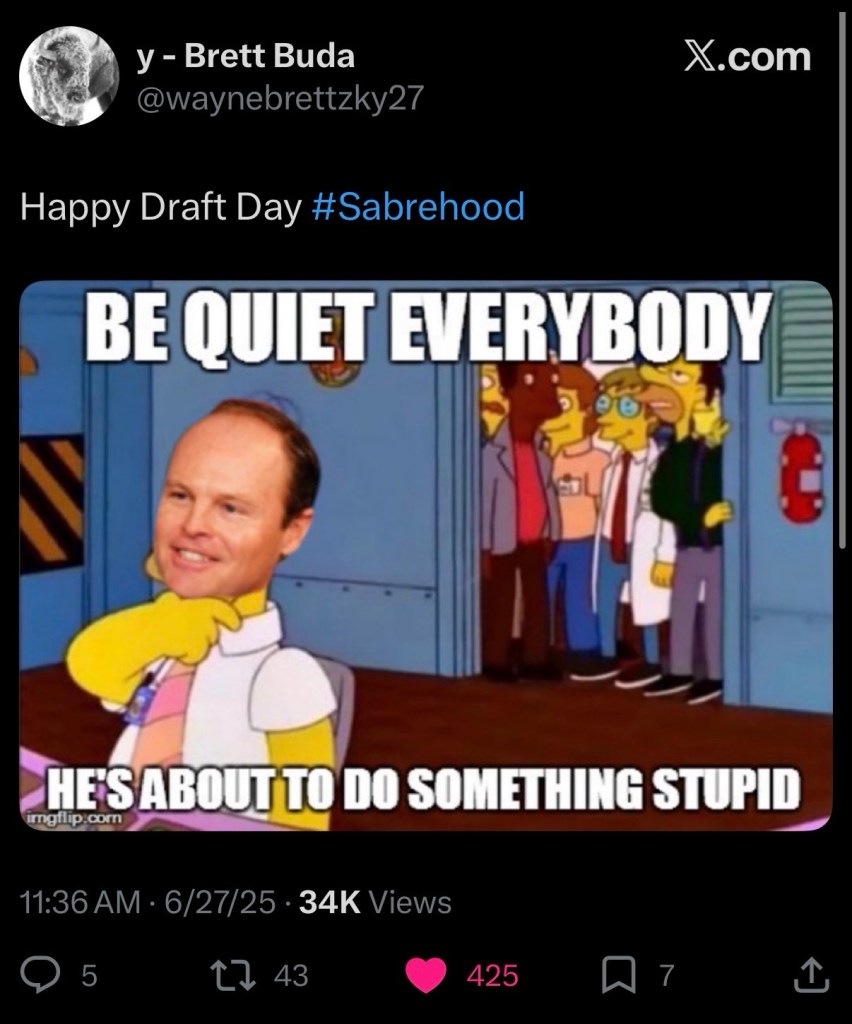
I’m going to try something daring – complimenting someone for their work during the drought.
Kevyn Adams took on one of the 32 jobs in hockey that every front-office employee dreams of, General Manager of an NHL team. Unfortunately, it was the equivalent of being gifted a Bugatti sitting at the bottom of the ocean. He inherited a flawed roster and below-below-replacement-level “hockey” coach, and was expected to produce a winner. The Pegulas had been very clear about maintaining a tight budget, and yet Adams was supposed to put together a winning product that would draw in fans. To top it off, he was considered the laughingstock of the league – viewed as a crony of the owner who got the job because he’d do what the guy cutting the paychecks expected him to do, even when that vision was totally misguided.
Adams was dealing with a mess that had been created by the three previous GMs, Darcy Regier, Tim Murray, and Jason Botterill. That’s a lot to undo, in itself.
A huge part of the problem during the drought was development. The Sabres seemed to draft some players that were regarded as very talented for their draft class over the first decade of the draft, but a lot of them never panned out. Darcy Regier’s last three drafts, 2011-2013, could be fairly judged at this point; the players were all into their mid- to late-20s. At that point, the results of those drafts were:
- Joel Armia, forward, 1st round, 2011: On December 23rd, 2014, Armia played 14:47 and had four hits in a 6-3 loss to the Detroit Red Wings. That was it for him as a Sabre; he got traded to Winnipeg in the Evander Kane deal in February 2015. He played 335 games over the next seven seasons in Winnipeg and with Montreal. He had scored 52 goals at this point, with career highs of 16 goals and 30 points in the shortened 2020-21 season.
- Mikhail Grigorenko, center, 1st round, 2012: The opposite of development, as he was rushed to the NHL unnecessarily. 68 games over three seasons in Buffalo; six goals, eight assists. Traded to Colorado in the Ryan O’Rielly deal in 2015. 149 games, 16 goals, 34 assists in two seasons. Three years in the KHL. He then returned to the NHL in 2020-21 with the Columbus Blue Jackets; 32 games, four goals, eight assists..
- Zemgus Girgensons, forward, 1st round, 2012: 509 games with the team, 61 goals. Missed the entire previous season with a hamstring tear. He had his best season in 2014, (15 goals, 15 assists) when the team had 54 points. A serviceable fourth-liner with a great nickname, “The Latvian Locomotive”.
- Jake McCabe, defenseman, 2nd round, 2012: 353 games over seven full seasons in Buffalo. Played 13 games in 2020-21 before his season ended due to a knee injury. His analytics were good, but his play suggested he was a second-pair defenseman, at best. Headed into unrestricted free agency that summer.
- Linus Ullmark, goaltender, 6th round, 2012: The best pick of these three classes. He started 20 games for Buffalo in 2015-16, his first year in North America, due to a rash of injuries that season; he was respectable, with an 8-10-2 mark, 2.60 GAA and .913 save percentage. Had played in Buffalo for the three most recent seasons, and had 88 starts, where he went 41-34-11 with a .911 save percentage despite playing on some poor teams. Also headed into unrestricted free agency that summer.
- Rasmus Ristolainen, defenseman, 1st round, 2013: 522 games in Buffalo.
Arguably the face of the drought. Played the minutes of a #1 defenseman, averaging 23:53 of ice time over his eight seasons with the Sabres; however, the analytics crowd thought he was as bad of a defensemen as they come. Although it is not the most useful statistic, his career plus / minus at this point was -163. At that time, it was the 24th-worst total in NHL history, and most hockey fans would only recognize two or three names besides his on that list. When on the ice, the Sabres only averaged 46% of the shot attempts taken, which is usually a predictive statistic of how likely a player will be successful; the farther below 50% you are, the less likely it is. Ristolainen ranked near the bottom of the entire league in that. The team’s expected goals were as bad as they got with him on the ice. If you wanted to win, you needed to minimize his time on the ice; instead, he usually led the Sabres in minutes on the ice season after season. - Nikita Zadorov, defenseman, 1st round, 2013: 67 games during the tank years of 2013-14 and 2014-15. Traded to Colorado in the O’Rielly deal. 344 games in Colorado and Chicago in the six seasons since: 344 games, 67 points, with a team average of around 44% shots taken while he was on the ice. He was considered to be a physical defenseman, which teams are commonly attracted to even with poor possession numbers.
- J.T. Compher, forward, 2nd round, 2013: Another piece sent to the Avalanche for O’Rielly. 271 games there, 53 goals, 56 assists. A serviceable third-line center.
- Cal Petersen, goaltender, 5th round, 2013: Played collegiately for four years at Notre Dame, and was a two-time finalist for the Mike Richter Award, given to the nation’s best goaltender. He had played 19 NHL games in the 2018-19 and 2019-20 seasons, putting up a .922 save percentage; in 2020-21, he became a full-time NHLer, with 35 games and a .911 save percentage despite a 9-18-5 record. You might notice, though, that I didn’t mention him in Part 2 of this series; that’s because after he used up his eligibility at Notre Dame in 2017, he told the Sabres he was going to test free agency rather than sign there. The Sabres tried to negotiate; he refused, walked, and signed with the Kings. Classic asset mismanagement.
- Nothing else of impact for the team.
There you have it. A bunch of guys in their prime years from three drafts, and all there is to show for it is Ristolainen; Girgensons; two pending unrestricted free agents in McCabe and Ullmark; and the remainder of the Ryan O’Rielly trade, which at this point was forward Tage Thompson, who seemed in over his head; Ryan Johnson, who was currently going into his junior year at Minnesota in the NCAA; and Colin Miller, a third-pair defenseman.
That is the recipe for failure.
The Sabres had essentially become the sort of job that you would create for yourself if you wanted to crank up the difficulty to its maximum on Franchise Mode of an EA Sports NHL video game.
The team that was on the ice had lost the will to win, or, for that matter, put in effort. The media has basically moved on from the team, and rightfully so – the Bills were now a perennial Super Bowl contender, while most Sabres fans would have been best served looking at the 18-year-olds in the upcoming draft that could hopefully be contributors two rebuilds into the future. NFL free agency got a ton of attention compared to the NHL trade deadline.
The fanbase was in its worst spot ever. When the team nearly went under in 2002, there was a huge problem with selling tickets, but on-ice play was only a small part of the issue; the Rigases had been handing out thousands of free tickets to games during their period of ownership, and everyone got used to getting their hands on seats without shelling out money. The team started winning, and the season ticket list went through the roof.
This time, the fans just didn’t care. The pandemic had changed the way people spent money and enjoyed their entertainment, and the idea of shelling out money for tickets to see a team that was going through the motions seemed dumb. The fans didn’t love or hate the team; they were apathetic, and that is not easily fixed.
Without hyperbole, the upcoming season was arguably the most pivotal season in the team’s history.
Adams did the only thing he could in that situation – try climbing out of a deep hole.
The 2021 Offseason
That spring and summer deserve a subheading of their own.
There were signs of life at the end of the 2020-21 season. In particular, coach Don Granato seemed to inject life into the team. They finished the season on a 9-11-2 run, which is not pedestrian at best, but given that the team had preceded it by losing 18 straight, it seemed like a miracle run. The players stated they were having fun playing again, and the offense began to actually show up at times. In a season of significant despair, some players expressed hope.
Granato was another first-time NHL head coach but was far from inexperienced – he was in his 27th year of coaching, had worked at every level of the sport, and did possess some head coaching experience in the AHL. He had developed a reputation as a players’ coach, and, just as importantly, a coach that was good at player development.
He was part of one of the great American hockey families, as well. His brother, Tony, played 14 seasons in the NHL and scored 248 career goals, then had a coaching career that included 2 1⁄2 seasons as the head coach of the Colorado Avalanche and winning Big 10 Coach of the Year on two occasions as the head coach at Wisconsin. His sister, Cami, was in the first class of women that were inducted into the Hockey Hall of Fame, based on her outstanding playing career with Team USA. Her husband, Ray Ferraro, had played 18 seasons in the NHL and scored 408 goals.
However, Granato could not fix everything, especially since most of what was seen as worthwhile was already broken and about to be sold.
The end-of-season media availability for the players on May 10th was a disaster for the franchise.
Jack Eichel, who was 375 games into his NHL career and had never been to the playoffs, led the way. He was still dealing with a herniated cervical disc in his neck that ended his season in March; he had been shut down for the season by the team, who stated at first that the purpose was for him to rehab his injury to be ready for the next season. During that time, Eichel went out and sought his own opinion; the recommended approach the consultation offered was an artificial disc replacement. This surgery was first approved by the Food & Drug Administration in 2007, and had been used by multiple golf players to relieve significant spinal injuries; the golfers had been able to successfully return to the sport with their pain alleviated. However, the traditional approach in most sports was to have an injured athlete undergo spinal fusion. A hockey player had never had disc replacement, and the Sabres (who had last word on the procedure that would be permitted) were not about to experiment on the concept with Eichel.
Eichel was livid about the team’s stance, and laid his feelings out plainly at locker cleanout day. “I’d be lying to say that things have moved smoothly since my injury,” Eichel said. “There’s been a bit of a disconnect between myself and the organization. It’s been tough at times. The most important thing now is to try to get healthy, figure out a way to be available to play hockey next year, wherever that might be.”
Eichel had a right to be worried about fusion surgery. If you’ve ever seen people that have undergone spinal fusion, they lack range of motion after the procedure, and often are unable to escape further fusion surgeries in the future. Many people complain that a certain level of pain persists from the injury even after surgery. Additionally, the recovery period is much longer for fusion (6-12 months) than disc replacement (8-12 weeks). Artificial disc replacement also leads to people having less pain in the future and a greater range of motion. When comparing each other’s experiences, everyone agrees that disc replacement is the better option.
For Eichel, it was about his quality of life moving forward. He made it clear he wasn’t about to back down about getting disc replacement done. The Sabres weren’t taking a chance. The staredown was officially out there for everyone to see.
He was not the only Sabre voicing discontent. Sam Reinhart was at 453 NHL games without experiencing the postseason. He had scored over 20 goals five times, including finishing 11th in scoring during the season that had just ended; however, Buffalo had repeatedly given him short-term deals, rather than committing to him long-term. He told the press that done with losing. “No one wants to go through a rebuild, especially into next year, turning 26 at the start of it or close to the start of it.” When asked what that meant for his future with the team, he said he “take some time to figure things out”. Later, it leaked that figuring things out meant either signing a one-year deal and testing the waters of unrestricted free agency or being traded.
Ristolainen had a lot to say as well. During the preceding regular season, he referred to Ralph Krueger as “the best coach I’ve ever had.” Whether he was being honest or sarcastic, that’s a heck of a statement. On May 10th, he struck a different chord. “Like I told Kevyn a little while ago I just said I’m open for all the ideas. Right now I mean it’s hard obviously the season just ended so yeah I’m frustrated, I’m pissed and it sucks so I told him I’m open for all the scenarios staying or if he trades me I’m fine with that too.”
Adams appeared to be prepared for the players’ takes, as he came back with the defining statement of his approach as GM at his end-of-year media availability on May 13th. “We are going to get this right with the people that want to be here.” In other words, the three didn’t need to worry about going through another rebuild in Buffalo – they were on their way out.
The offseason got underway in late July due to the schedule being altered by the pandemic two years before. Luckily, the league would be back into its regular schedule pattern in 2021-22, with the Stanley Cup being awarded in its traditional mid- to late-June window.
The league offseason (which now perennially began two months after the Sabres had) started with the NHL Draft Lottery. Unsurprisingly, the Sabres had finished the previous season with the NHL’s worst record, finishing six points behind the Anaheim Ducks. This gave them the best odds at winning the top pick in the lottery, albeit those odds were only one-in-six. The Sabres won the roll of the dice and got the top pick overall.
There was also an expansion draft, as the Seattle Kraken were going to create symmetry by giving the league 32 teams, or eight in each division. The Sabres were going to lose a player of some value, as under the expansion draft rules, there were not enough spots to keep every talented player that could generate interest. Most of the exposed players under contract for next year that had been on the NHL roster were safe despite being available.
- Jeff Skinner was getting paid $9 million per year for the next six years and had scored 23 goals in the past two years. Most people considered his contract to be the worst in the NHL. Most interestingly, he was now 773 games into his NHL career and had never experienced the playoffs, which was an NHL record at that point. The Sabres knew they weren’t unloading that deal, but tried to see if the Kraken were asleep at the wheel.
- Kyle Okposo was getting $6 million a year for two more years and had 11 goals over the last two years, along with four concussions during his five years in Buffalo. He was going nowhere, either.
- Girgensons. See above.
Only two players appeared to be intriguing – defensemen Miller and Will Borgen.
Borgen had played 14 NHL games but was an analytics darling, and a significant contingent of the remaining Sabres fans were upset that the Sabres left Borgen exposed, rather than putting Ristolainen out there. Right-shot defensemen are considered to be a premium asset in the NHL, and Ristolainen fit that bill to a T. He was big and liked to play physical, which was always attractive for people in the traditional NHL mindset. Still, the numbers spoke loudly.
Sabres fans figured that Borgen would be much more attractive to Seattle than Ristolainen, and if Ristolainen had been left exposed and got picked, it was not much of a loss.
Of course, the Kraken picked Borgen, but Sabres fans that were upset were also wrong in their assessment of the situation. You’ll see why that is soon.
The NHL Draft was on July 23rd and 24th. Usually, the draft is a hotspot for offseason trade activity because the executives are all in an arena together, giving them a chance to have face-to-face discussions and better opportunities to persuade one another into giving up that asset they have been hoarding. The 2020 Draft was virtual because it was at the height of the pandemic; the NHL decided to play it safe and go virtual again this year.
This didn’t stop Adams from getting to work on changing the team dynamic. Ristolainen was the first to go. If the Sabres wanted a solid return, they needed to find a sucker out there.
The Philadelphia Flyers were glad to be that. The Flyers franchise has always tried to be big and physical; Ristolainen was that if nothing else. The Sabres unloaded him to the Flyers the day of the draft for a 1st-round pick that night, a 2nd round pick in 2023, and defenseman Robert Hagg, who at least could be a depth piece.
The Sabres now had two 1st-round picks that night. The prize of what many considered a draft that was deep but lacking high-end talent was defenseman Owen Power, who was committed to go to play at the University of Michigan in the fall. The Sabres picked him at #1, which was a great decision for both the team and more so for me, as I could now buy a jersey with my name on it without being that guy wearing a customized one. The Sabres used the Flyers pick (14th overall) to take Swedish winger Isak Rosen, who had flashed potential in the Swedish top-tier league. The rest of the draft (which occurs on the following day) saw the Sabres draft several intriguing Russians, which went away from a long history of avoiding prospects from that country, and 7th-rounder Tyson Kozak, who has developed into a serviceable fourth-line center for the team.
Adams also continued to reshape the franchise’s look that day. Reinhart was dealt to the Florida Panthers for a 1st-round pick in 2022 and goaltender prospect Devon Levi, who was considered undersized but had flashed some promise in international best-on-best tournaments.
The Sabres had two notable unrestricted free agents hitting the market on July 28th – McCabe and Ullmark. McCabe had made it clear he was not returning, and Adams made no effort to bring him back; he left for the Chicago Blackhawks. Ullmark, on the other hand, was a player the Sabres wanted to retain. The Sabres knew re-signing him would be difficult, but chose to keep him at the previous trade deadline and see if they could get him on a long-term deal. In situations where players are happy with where they’re at, they’ll often take a hometown discount, which means taking less than what they may be able to make on the open market. Ullmark was willing to stay in Buffalo; however, he wanted a hometown premium – meaning the Sabres would have to pay a lot more and add extra years on the contract compared to what was out there. The Sabres liked him, but Adams was not going to pay the premium; Ullmark went to Boston.
The Sabres were quiet in bringing in free agents, most notably (using that term loosely) adding defenseman Mark Pysyk (who was returning to Buffalo) and goaltender Craig Anderson, who had enjoyed a good career but was now 40 years old.
2021-22
The team reported for training camp on September 22nd. Eichel showed up. Unsurprisingly, he failed his physical.
Adams did not mess around; he responded by stripping Eichel of the captaincy. “Unfortunately, yesterday, Jack did not pass his physical,” Adams said on the 23rd. “To this point, Jack is not willing to move forward with the fusion surgery that our doctors are suggesting. So we’re going to continue to work towards solutions.”
The Sabres actually started pretty well on the ice, going 5-2-1 in October; best of all, after a season without offense in 2020-21, the Sabres started off by averaging 3.13 goals per game.
Vibes on the ice had improved. You might say the team had found paths of rhythm among their instinctive travels.
The Eichel thing still loomed. The Sabres had been actively shopping him, with Adams supposedly looking for four quality pieces; no one had met their price to that point. The Sabres were focused on unloading him that season, as he had a no-movement clause that went into effect in July 2022 (players can have no-movement clauses go into effect in their contracts after seven seasons of NHL contract service). Adams was willing to be patient. Suddenly, Eichel’s agent announced that he was having a sit-down interview with ESPN on November 4th – an opportunity to say his piece about the injury situation and standoff with the Sabres.
Adams wasn’t about to let that happen. Before Eichel could sit down with the cameras in the afternoon, he was dealt (along with a 3rd-round pick) to the Vegas Golden Knights for forwards Alex Tuch and Peyton Krebs, a 2022 1st-round pick, and a 2023 2nd-round pick. It was less than what Adams wanted, but fortunately, it was over.
The Sabres had one final problem with the trade: they were now under the salary floor. The Pegulas weren’t kidding about cutting costs before the pandemic hit; since the team had little gate revenue in the 2020-21 season and the team wasn’t winning anyway, the owners went bare-bones on the budget for the team. However, the collective bargaining agreement doesn’t let teams just sandbag it; they have a minimum amount they’re required to account for on the cap. The league’s floor for the season was $60.5 million; with the Eichel trade, the Sabres dropped to $56.4 million, even though they had a total of $21 million tied up with Skinner, Okposo, and Dahlin ($6 million). Trading Eichel ($10 million) for Tuch ($4.75 million) and Krebs ($526,674) had pushed the payroll about $4.1 million under the floor. The solution? They traded for Johnny Boychuk from the New York Islanders. He was making $1.1 million cash, but with a cap hit of $6 million. Boychuk had retired in 2020 due to an eye injury; he was essentially a placefiller on the cap. The Sabres provided future considerations (a turkey sandwich) in return.
The season was a huge step forward for the team. Adams seemed to have found the right tact in stating that he wanted players who wanted to be a part of the team. They lacked top-to-bottom talent but played hard; hockey is in part an effort sport, and Buffalo fans respond to teams that work hard. The results were poorer after the Eichel trade, but they ended the season on a 16-9-3 run. The previous season, they played at a 54-point pace; they improved to 75 points for this season. They were 25 points out of the playoffs, but the Eastern Conference was extremely top-heavy for the year; they actually finished in 11th place, only nine points behind the nine-spot.
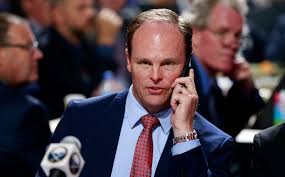
Tuch was a seismic shift from Eichel. Though not as talented, he was gritty and played a full 200-foot game. Additionally, he made it clear he was one of the guys who wanted to be in Buffalo. Notice the still from the introductory press conference above: he’s smiling. He had just been traded from Vegas, a team that had played in the Stanley Cup final and two Western Conference Finals during his four years there, to Buffalo, a team I’ve now used over 14,000 words to explain their ineptitude over an 11-year span. His response? Excitement.
A Syracuse native, he grew up next door to former Sabre star Tim Connelly and was a huge Sabre fan during childhood; in his initial presser, he rattled off a bunch of Sabres from the great Sabre teams of the mid-2000s, including some that only a fan would remember well. He knew the fanbase and how things could be when the ship was upright. “They love their sports here and they love their Buffalo Sabres,” he said. “I’m really excited to play for a fanbase like this. I mean, I was very thankful to play in Vegas where they really embraced us, the entire city embraced us. But coming to Buffalo, it’s gonna be like none other.” Tuch had a career-high points-per-game average, with 38 points in 50 games in his first season as a Sabre.
A lot of people credited Granato (who had been affectionately nicknamed “Donny Meatballs” during the season) as a key part of the improvement. Dahlin had a year with significant progression, and started to look the part of a #1 defenseman; his 13 goals and 53 points were easily career highs. Skinner and Okposo had massive bounceback years – Skinner tied a career high with 63 points with 33 goals and 30 assists, while Okposo arguably had his best season as a Sabre, with 21 goals and 24 assists. Forwards Dylan Cozens, Casey Mittlestadt, and Krebs, along with defenseman Mattias Samuelsson, each showed that they were prepared to become lineup regulars.
The name that popped, though, was Thompson. Almost everyone in hockey had decided by 2021 that he was never going to match the promise of being a 1st-round pick, and that included most of the Sabres’ brass. Allegedly, Adams had strongly considered dealing Thompson to a contender in exchange for a 5th-round pick in 2020, but backed away from making the deal. It was the best deal in franchise history that was never made.
Granato felt he had a piece he could work with in Thompson, even though he had career totals to date of 18 goals and 15 assists in 145 games and looked like he could easily be snapped in half by a well-placed check. Granato figured out how to unlock his abilities: he moved him to center. Granato offered in a radio interview that he felt Thompson was not able to ideally use his abilities playing against the wall, and that moving him to the middle would give him more room to operate. That analysis was spot-on. Thompson scored 38 goals (19th most in the NHL) and 30 assists in 78 games. It wasn’t just him doubling his career averages in shots-per-game and shooting percentage while getting five minutes more ice time per game; it was the tools he possessed that everyone now got to see. He possessed one of the fastest shots in the game and was extremely accurate, to boot. He also could handle the puck like few others in the NHL; some of his goals were SportsCenter Top-10 caliber. The change in his play was unreal. He had definitely put in the work to improve, and Granato put him in the best position to succeed.
The most notable game of the season was a home matchup with the Golden Knights in Buffalo on March 10th – the return of Eichel, now in an opposing uniform. The fans were merciless. A crowd of 12,437 booed Eichel every time he touched the puck. It was a tight game, with Krebs opening the scoring against his former team in the 1st period. Things got nasty.
Vegas tied it early in the 3rd period; the Sabres grabbed a 2-1 lead with 3:44 to go on a Victor Olafsson power play goal.
The Knights pulled their goalie in the final moments to try and get the tying goal. The end result? A dream come true for Sabres fans.
Yes, that was Eichel turning the puck over to Tuch at the blueline, and Tuch getting the empty netter. 3-1 final, and Craig Anderson won his 300th career game, to boot.
Eichel was livid afterwards, and went in on the Sabres’ fans in his postgame scrum.
The Sabres fans showed in subsequent matchups with the Knights that they could boo even louder, per Eichel’s suggestion.
Broadcaster Rick Jeanneret retired at the end of the season. He was working a limited schedule as it was; most men in their 80th year aren’t working at all, but Jeanneret was game. It was his 51st season working for the franchise; he thought it would have been nice to finish with a round number at 50, but he came back for one final season because he didn’t want his final year to be one without fans. The Sabres hung his name in the rafters on April 1st. His career ended with a 3-2 overtime win over the Chicago Blackhawks on April 29th, a fitting end to his legacy. Those two games were the only two sellouts of the season.
Attendance was the biggest problem of the year. It was, in a word, atrocious. The poor effort, combined with the pandemic giving people a chance to reconsider where they spent their disposable income, had killed the gate receipts. They averaged 9,997 home fans for the year. Those attendance numbers include an outdoor game in Hamilton against the Maple Leafs where the Sabres were considered the home team (even though the place was mostly pro-Toronto), and attendance for the 40 games at Key Bank Center was 9,595 fans, or 50.3% of capacity. The only seasons with lower overall attendance were 1970-71 and 2020-21. The 2020-21 season was due to COVID restrictions. The 1970-71 season was the first for the franchise; Memorial Auditorium only held 10,449 at that time, because the roof had yet to be raised to fit in the oranges. Therefore, they played at 93% capacity that inaugural season. The Pegulas may have cut the budget, but not before they alienated the fanbase, making the whole financial scale feel right-sized.
The 2021-22 team was reminiscent of the squad back in 1995-96, where they traded away some talented players and started a youth movement; Ted Nolan coached that team, and the fans loved him from then on, as well. The big difference was that the 1995-96 team also had Dominik Hasek. The current edition of the team had a sub-.900 save percentage, and that would need to be fixed if the team were going to progress further.
2022-23
The fanbase got a chance to take a breather after an insane two years. The team bottomed out before the rebuild even started; year one of this try actually was an improvement over the previous one, where they spent money and had tons of highly-regarded players. There were multiple foundational pieces in place. For once, no one was asking to leave. Even if winning still appeared to be a ways down the road, the vibes were positive.
Although attendance trended northward towards the end of the year, there was no way the Pegulas were about to open the pursestrings this soon. They mostly seemed to be more interested in winning a Super Bowl in Orchard Park at this time. That was probably good; owners usually have the most success when they write the checks and stay out of the way of the people that run personnel. When the Pegulas had previously intervened, things seemed to go poorly. Ville Leino is the perfect example. The Pat LaFontaine debacle in 2013 had their hands all over it, too; if it had been a simple difference of opinion, there would have been no need for LaFontaine to sign a non-disclosure agreement on his way out.
The Pegulas are not alone in having this issue. The Cowboys haven’t won a Super Bowl since Jerry Jones decided he was the best football mind out there in the mid-1990s; the Davises have also poisoned the team culture with the Raiders, regardless of where the team is located. The Knicks struggled for years when James Dolan wanted to put his hands in everything.
Yes, the budget wasn’t going to improve, but it wasn’t like there was anyone beating down the door to be a Sabre, either. The drought was now 11 years old. The answer would have to come from sound personnel decisions.
The offseason started with one simple move: ensure the team made it to the salary floor again. Adams did this by trading for goalie Ben Bishop of the Dallas Stars. Bishop had a cap hit of $4.91 million, and was fine with being on the Sabres payroll – just like Boychuk, he was retired. In his situation, he had a degenerative knee condition. The Sabres acquired him on June 10th along with a 7th-round pick that summer for future considerations. The future considerations ended up being a greeting from George W. Bush on television during a Texas Rangers game, shown below:
Hold on, I’m wrong; that was from 2017. I guess it was the thought that counted.
The Sabres had three 1st rounders in the 2022 NHL Draft – their own at #9. #16, which they acquired from the Golden Knights in the Eichel deal; and #28, which had belonged to the Panthers until they swapped for Reinhart. The Sabres took three centers: Canadian Matthew Savoie at #9, Swede Noah Ostlund at #16, and, at #28, Jiri Kulich. In the 2nd round, they became the first team to draft a goalie that year – Finn Topias Leinonen.
The Sabres made two minor signings in free agency. The goaltending concerns were addressed by signing Eric Comrie from Winnipeg to a two-year deal at $1.8 million per year. Comrie was a low-risk, high-reward type of move. He played 19 games the year before as backup, with a 10-5-1 record, 2.58 GAA, and .920 save percentage. If he could replicate those numbers over 35 games, he was a steal. If he flopped, it was far from a financial issue. They also signed journeyman defenseman Ilya Lyubushkin to a two-year, $2.75 million per year deal.
The big thing the Sabres did was take bets on the future. Thompson was a year away from restricted free agency. The previous year had been phenomenal. However, people questioned whether it was sustainable. Adams bet that it was; he signed Thompson to a seven-year,$50 million contract to start in 2023-24. Then, the day before the season, Adams took another shot: defenseman Samuelsson, with 54 career games under his belt, got seven years and $30 million starting after that season, as well.
The fans were excited about a big return this season – the third jersey was a return to the black, red, and white “goathead” jerseys, worn from 1996-2006. They were a huge hit, and flew off the shelves.
The inconsistency shown last year continued into this one. They started 7-3-0, then dropped eight consecutive in regulation. Among those eight losses was a 7-4 home loss to the Golden Knights. Eichel scored the Knights’ final three goals and enjoyed every second of it.
I might be a Sabre fan, but I love how he leaned into the heat from Buffalo with his celebration of the first goal. Also ridiculous was finishing the hat trick with a goal shot from the opposite goal line; it was even funny to see hats fly to the ice for him, considering his popularity in Buffalo now ranked alongside Tom Brady and ranch sauce with your wings.
The losing streak was then followed by an 11-3-2 run to end 2022. That left them at 18-14-2; a winning record, but still 11th in the conference at six points out of a playoff spot.
The offense had become a juggernaut; the Sabres were averaging 4.02 goals per game, easily leading the league. The top line was phenomenal. Thompson already had 27 goals and 24 assists. Tuch (39 points) and Skinner (38 points) both had 17 goals. Cozens also took a major step forward, with 11 goals and 21 assists. Olafsson had 13 goals. Mittelstadt was now a legitimate playmaking center. Rookie forwards Jack Quinn and JJ Peterka were starting to find the net, as well.
The defense was suspect, which is normal when you’re playing a wide-open style of hockey. They were giving up 3.34 goals per game. Dahlin, though, now looked the part of a #1 defenseman, and Samuelsson had developed a reputation as a defender that could take away space, even when beaten on a play. Power was in his first full season and showed initial flashes of promise.
Was it all falling together?
The team was in the thick of the playoff hunt going into February. Cozens had a major part of it; he was coming up on restricted free agency that summer. Adams tried to get out in front of his value flying sky-high, too; he signed Cozens to a seven-year, $49.7 million deal, starting in 2023-24. It was intentionally just less than Thompson’s deal, but still a bunch of money for him during his breakout season.
Adams carefully approached the deadline; on March 3rd, they were in a four-way tie for ninth in the conference and four points behind the second wild card team, the New York Islanders, but had played four fewer games. Adams decided to be a cautious buyer. He dealt away forward Rasmus Asplund, who had fallen out of the lineup, for a 7th rounder, and goalie Erik Portillo, who had no intention of joining the franchise, to the Kings for a 3rd-rounder that summer. He added Jordan Greenway, a big (6’6”) forward that played a heavy game, for 2nd- and 4th-round picks.
The Sabres unfortunately had a 2-3-2 run in the next two weeks, and were now six points back in 11th place with just 14 games to play. They did have one final trick up there sleeve, though – Levi. Levi’s two years at Northeastern University were lights-out. He won the Mike Richter Award both years, with a 1.54 GAA and .952 save percentage in 2021-22 and 2.24 GAA and .933 save percentage in 2022-23. He was the first two-time winner of the Richter Award and had the second-highest save percentage in NHL history. The Sabres hoped that they had found their goalie of the future, but needed him immediately: Anderson was showing signs of fatigue, while Comrie and Ukko Pekka-Luukkonen (UPL) had sub-.900 save percentages.
Levi was given two weeks to prepare, then thrown into the net for the Sabres for the first time on March 31st. At this point, things looked bleak – they were seven points out of the second wild-card spot with nine games to play and a total of three teams to pass. Levi had seven starts and went 5-2-0; unfortunately, the Sabres were eliminated in Game #80, a 6-2 loss to the Devils. They finished tied for 9th in the conference, just one point behind Florida, the second wild-card team.
There was a lot to feel good about. Yes, the drought was now at 12 years. However, it was the first time the team had a winning record (42-33-7) since 2011, as well as the first time they had improved in consecutive years. Thompson had 47 goals. Thompson, Skinner, Tuch, Dahlin, Cozens, and Mittelstadt all had career-high point totals. Levi had a .905 save percentage in his first seven NHL starts. Western New York was buying in again, as well; attendance went up nearly 6,000 fans per game and the arena was at 81.6% capacity for the season.
The team that finished one point ahead of us and in the final wild card spot? The Florida Panthers. They went on a run in the playoffs, making it to the finals, only to lose to… the Golden Knights. The leading scorer in the postseason? Eichel, 26 points. Roll the ugliness…
2023-24
The Sabres had their lowest initial pick in the draft in a decade – 13th. That’s usually outside of the elite talent pool. The Sabres got lucky, though – left wing Zach Benson fell into their laps. He has played 211 games since that draft – all of them in a Buffalo uniform. That’s third-most in that draft class. He has 34 goals and 67 assists so far, making him the 6th-leading scorer from that draft class; the five ahead of him were picked in the Top 7. He has the best career plus/minus of anyone from that draft. He’s totally obnoxious, and people hate to play against him. His teammates constantly poke fun at him – because he’s beloved in the locker room. He scored what may be the most beautiful goal in NHL history:
Of course, it was a nationally-televised game.
Best of all, he’s just scratching the surface. He’s easily the best pick the team has made outside of the top 2 in the draft since the 2004-05 lockout.
This season was a step sideways. I think Adams believed that a minor tweak along with some improvements out of a young team would lead them to the playoffs.
The budget was going to still remain minimal; the Sabres payroll no longer needed a retired player to make it to the floor with Thompson, Cozens, and Samuelsson getting large pay increases. Still, the team was not about to approach the cap. The organization tried to spin the narrative that the team was leaving room for other young stars when their contracts were up, but there was just a single one-year deal to fill the multiple holes in the roster that still existed while saving that future cap space.
The Sabres did sign two notable free agents: defenseman Connor Clifton, formerly a Bruin, got three years and $9.99 million, and Erik Johnson, a 14-year veteran, got one year and $3.25 million. They even brought Okposo back for one year and $2.5 million, seeing him as a helpful veteran presence.
The team made a couple of long-term investments on the back end. Dahlin was a year out from a new deal, and two years away from being eligible for unrestricted free agency. He was also eighth in goals and tied for fifth in scoring amongst defensemen in the whole league the previous season. He was officially a #1 defenseman. He got paid like one: eight years, $88 million, the richest contract in team history. Power only had one full year in the NHL, but his entry-level contract was also coming up next year; the Sabres gambled with him, giving him seven years and $58.45 million, or $8.35 million per year. That would be the 16th-biggest hit for any defenseman in the league. His job became living up to his promise.
Granato had decided that the reason the team missed the playoffs the previous year was due to poor defensive play. To be fair, the team was 27th in goals against in the league in 2022-23; however, their save percentage was .896, which ranked 23rd. If the Sabres had gotten a few more saves, they could have snuck into the playoffs.
The good vibes disappeared from the previous season. Granato did not tweak the system; he basically rebuilt it. It was not better. The team dropped their goals-against average by more than ⅔ of a goal per game, and ranked 11th in the league in that category. The offense similarly cratered, dropping down to 2.98 goals per game. The save percentage was middle-of-the-pack, with a .903 mark; better, but because the offense was less remarkable, not enough.
Adams decided that it was time to start adjusting the roster at the trade deadline. He was worried that the current construction was good, but not good enough. He did something rarely done in the league any more: he made a hockey trade. Mittelstadt was traded to the Avalanche at the deadline for defenseman Bowen Byram. Bryam was in his fourth full season, was a solid second-liner on one of the best bluelines in the league, and had won a Stanley Cup with the team in 2022. Mittlestadt was one of the few Sabre offensive players enjoying a good year.
The trade meant little for that year; the Sabres had a positive goal differential for the first time in the draft, but that does not equal points in the standings. They dropped to 84 points for the season, seven points less and seven points back of the final team in the playoffs.
Granato had changed the culture in the room and developed players; however, the team was unsure he could get them forward another step. He was fired the day after the season ended.
Two fun notes from the year:
Skinner played his 1.000th game on April 2nd, a 6-2 home win over Washington. He was the 399th player in league history to make that milestone. He was the only player that had reached that mark without a single playoff appearance.
Okposo wanted one last crack at a Stanley Cup. The Sabres granted that, sending him to the Panthers for a 7th-round draft pick that could convert to a 5th if the Panthers won the Cup. The Sabres got the 5th-rounder because Okposo got his Cup. His teammates included Reinhart, Evan Rodrigues, Brandon Montour, and Dmitri Kulikov, all alumni of the drought themselves.
2024-25
The Sabres’ management figured it was time to look for an established coach with significant success in the league. The hot coaching candidate on the market at that time was Craig Berube, who had won a Stanley Cup in 2019 with St. Louis (we’ve already been through that one). At the time of Granato’s firing, Adams was pleasant about the former coach’s run while saying that he had the perfect candidate in mind to bring the team to the next level. Many were hoping it was Berube.
It was not. He went to Toronto. It felt similar to losing Mike Babcock back in 2015 to the Maple Leafs.
The new coach also had a familiar feel. That’s because Lindy Ruff was the choice.
Lindy was a finalist for the Jack Adams Award in New Jersey in 2023 after the Devils made a 49-point improvement from the previous season and reached the second round of the playoffs. The Devils stumbled the next season, and were eight points out of a playoff spot when the Devils fired him with 20 games left; the Devils never moved closer to the playoffs in the stretch.
The Sabres’ draft was headed by the 14th pick, where the Sabres took Finnish center Konsta Helenius; Helenius was considered the 3rd best European skater, but fell below several lower-rated prospects in the selection process. The Sabres were excited, as he had experience in Finland’s top professional league; he was brought over to the states and spent the season with the Amerks, where he got to play 65 games and scored 35 points. He also got eight games of playoff experience.
Ruff had a significantly different system from Granato; it had its own offensive flair, but involved a lot more forechecking. The Sabres added to their forechecking by trading a 2nd-round pick in the 2024 NHL Draft to the Capitals in exchange for Beck Malenstyn. He had his first full year in the NHL in 2023-24 at age 26; he had six goals and 15 assists on the season. The price was mocked roundly for the Sabres giving up that high of a pick.
The Sabres also decided that Skinner would not fit the new system, given his disinterest in the defensive half of the ice. Skinner had three years left on his eight-year, $72 million pact; although there would be a savings of over $7.5 million on the cap for the upcoming year, the cap hits would raise to $4.4 million in 2025-26 and $6.4 million in 2026-27; there would be another three years of $2.4 million hits afterwards, meaning he would be on the books until 2030. Additionally, they moved on from “The Latvian Locomotive” Zemgus Girgensons, who had given the Sabres 688 games over 11 seasons, chipping in 89 goals while the team went nowhere; he signed in free agency with the Lightning for three years. They also saw Victor Olafsson leave in free agency; his last 1½ seasons in Buffalo had been a dud, and he was getting fourth-line minutes while really being a power-play specialist, at best. He would have been a poor fit in Ruff’s system.
The Sabres needed a defensively-oriented center for the top 9; they found a willing trade partner in Edmonton. The Sabres had a plethora of forward prospects in the system, and not all of them would fit in the puzzle; the Sabres decided to move 2022 1st-rounder Savoie in exchange for center Ryan McLeod and a minor leaguer.
The Sabres again decided to try and invest in the future based on some decent short-term results. UPL had shown flashes of excellence in 2023-24, and was a large reason the Sabres improved defensively; the team had hope he could settle into a #1 role after showing he could handle the load that season. 54 games, 2.57 GAA, and a .910 save percentage in his age-25 season suggested he was ready to handle the crease as a #1 long-term. The Sabres got out in front of things and paid him $23.75 million over five years.
The adjustments seemed to work well, but the team was flat as a whole. An 11-9-1 start went for nothing, because it was followed up by going winless over 13 games. Once again, the season was over in the eyes of the fans before Christmas, with the second-fewest points in the lead and sitting 10 points behind the second wildcard spot.
The fans were now agitated with Adams. Obviously, a 13-game losing streak says a lot about the product on the ice. However, letting that product stay the same on the ice without making a call-up or waiving a player, let alone making a trade, gives the impression that the status quo is acceptable. The Sabres were 25-20-3 the remainder of the way; the season was lost during that losing streak, which suggests that the team was not fatally flawed. Losing that many games in a row, though, was obviously sanctioned, because Adams sat still while the ship sank.
What more is there to say? There are a lot of different people to blame in this entire drought. If you could break it down to the basics, starting with coaches:
Lindy Ruff, 2011-13 – His message got stale, and the players tuned him out. It happens to a lot of coaches; there’s only so long you can use the same approach before everyone stops listening. That’s why most coaches don’t survive long in the NHL. The average tenure of an NHL coach is about 2.4 years, or around 190 games; Lindy was the third-longest tenured coach in one position in NHL history, trailing only Al Arbour, the New York Islanders coach that led them to four straight Stanley Cups in the early 1980s, and Jack Adams, the namesake of the Coach of the Year Award in the NHL (both coached 20 consecutive seasons).
Ron Ralston – He was good as a developmental coach, which is why he had some success in Rochester; the NHL is not about development, it’s about results. He could not produce them.
Ted Nolan – A mythical figure in club history that had a disservice done to him in being brought back when the clear goal was to make the franchise embarrassingly bad. He preached effort and definitely got it from his players in an entirely bleak situation. At the end, he was thanked for guiding them to the bottom without any real consideration of whether he should have the chance to coach a team that was built to at least compete.
Dan Bylsma – Take away the Stanley Cup run in the first season of him as a head coach in Pittsburgh (mind you, he was a late-season replacement), and he was unremarkable as a head coach in the NHL. He won a lot in the minors, but once again, that does not always translate to the NHL. Also, it’s pretty easy to make the playoffs every year when your top two centers are Sidney Crosby and Evgeny Malkin in their prime years.
Phil Housley – He may be one of those guys that is great as an assistant but not meant to be the top guy in the organization; that does not make him bad, it just leads to him repeatedly running into dead ends. (It’s called the Peter Principle – think of Michael Scott, in particular.) He also was doomed the second Jack Eichel was named captain; Eichel was in charge from then onward.
Ralph Krueger – Wrong profession entirely.
Don Granato – He may have done the best job given the circumstances he faced. However, he got in his own way by questioning his style; he probably would have been better off doubling down on his style and leaning into being an offensive-minded team, rather than going away from what was working with the talent he had.
Lindy Ruff, 2024-25 – Not to absolve him, but he was not offered the help he needed when the wheels were coming off. Take away that losing streak, and they were on a 94-point pace; even with seven points during that streak (say, 3-9-1), they are able to make a move more akin to being a buyer at the deadline rather than sitting still.
Let’s go to the next rung up the ladder, to the General Manager position:
Darcy Regier – A master of decision-by-indecision; he always seemed to be too slow in making moves. There’s a reason fans would scream, “Do something, Darcy!”, at home games for years; he just never made moves when the finishing touch was needed. Several GMs said after they were out of the game that Darcy only wanted to make a deal if he felt he was going to get one over on you. That may seem like a sound strategy, but realistically, it gets you nowhere, because then teams are wary of what you’re trying to do – they question what is wrong with your asset, in particular, which means you’re considered to be dealing in bad faith. Even when you look back at the best period of the franchise under him, the 2005-06 and 2006-07 teams, he made one deal for incoming talent at those two deadlines, where he added Dainius Zubrus, hardly a barnburner of an addition. Also, you saw at the beginning of this part about where the last few drafts went – nowhere. It was time for him to go.
Tim Murray – A little too over-the-top at his job. Toronto rebuilt in roughly the same window as the Sabres; they stripped some very good parts, but they didn’t remove everything that wasn’t nailed down. To quote Nolan, “Prospects become suspects,”, and if that prospect was showing the least bit of promise, he was probably dealt for a 3rd-round draft pick, anyway. When the big talent showed up, he didn’t have enough around it to compliment them. There’s another part to this, too – the three big trade acquisitions were not exactly known as on the straight-and-narrow. O’Rielly has redeemed his image as he has matured, but had gotten into contract issues exacerbated because he played in the KHL and got hurt during the 2012-13 lockout, then picked up a DUI three weeks after getting traded to Buffalo by hitting a Tim Horton’s (sacrilege in itself). You read the fun of Evander Kane in part 2 of this retrospective. Lehner had documented mental health problems that were not out there, but Murray would definitely have been aware of, as he came from Ottawa when hired by Buffalo. He also gave Eichel unlimited power by throwing away two seasons just to ensure he could draft him. Gambles don’t always work; however, he was chasing a big loss without success.
Jason Botterill – Seattle Kraken fans feel our pain. He let the inmates run the asylum, and instead of calling out the dysfunction, he fed into it by appeasing the players in the building. I can’t believe he got another GM job.
Kevyn Adams – Fixed the culture and dealt with reduced budgets. Working closer to the salary floor is not ideal, but the Sabres managed to make a bunch of playoff runs under Ruff in the pre-salary cap era with budgets way below the big boys, and Adams seemed to figure out how to be competitive. However, he also ran into the same problem as Regier, in that he developed paralysis-by-overanalysis. It’s okay to be slow and methodical when things are being built, but sometimes, you have to make a move to get yourself over-the-top, and Adams never did that.
There is only one common thread through the drought, of course… the Pegulas.
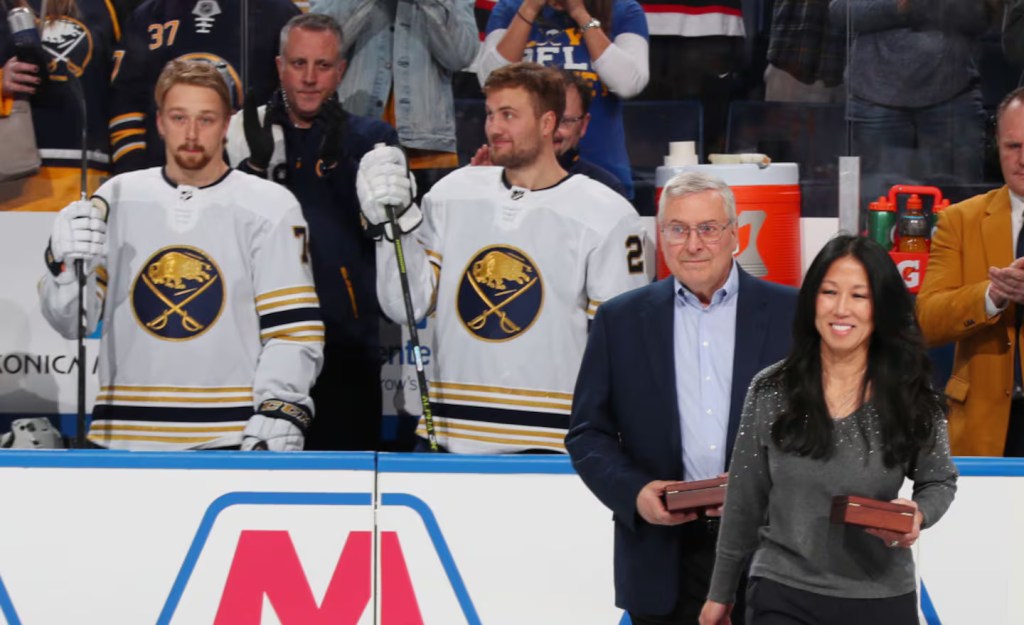
I think Terry Pegula is ultimately a good guy with the right intentions. He is protective of the franchise and always makes real efforts to put Buffalo in a good light. He’s done a lot to upgrade the area around the arena, especially by adding HarborCenter, which a lot of NHL personnel have raved about – both in having a practice facility to make use of as well as having a Marriott right next to the arena (trust me, other owners and out-of-town writers take note of these things). He’s brought hockey events to the city, such as the World Junior Championships, the NHL Scouting Combine, and the NHL Draft (coming for a second time in June 2026), which is a lot more than they’ve ever gotten before.
At the same time, he’s run into a lot of problems as an owner. Once again, I am not going to see the budget as an issue – it did not sit well with the fanbase and the off-ice personnel when the discussion about spending and their lifestyle occurred, but the team was a mess, anyway, and there was no spending their way out of that problem.
However, there are other things that have not gone well. Early on in his ownership tenure, there was a much-discussed behind-the-scenes meeting with him and several members of the Buffalo media where he pointedly chastised them for criticism of the Sabres, basically alluding to them being a part of the problem of finding success. That is a good way to make the critics even more vocal, and when things went wrong, they were more vicious.
Also, for a man who values the history of the franchise, he’s done a lot to alienate some of the figures that are held in high esteem. There was a period where all of the franchise highlights displayed in the arena were from his ownership tenure – one that was far from illustrious. LaFontaine and Nolan were completely dismissed from the franchise lore.
He also fell victim to the toughest lesson of sports ownership, which is that your job is to hire the right people and write checks. When you throw around hundreds of millions of dollars at a business, you have the right to do what you want with it. However, all actions have consequences. Building a great hockey team is not like drilling wells; the intangibles are not something that are easily replicated, and chemistry means just as much as anything. The concepts that run a business do not translate to building a collective group moving in the right direction. There will be business decisions throughout, but it is never as simple as a cost-benefit analysis that you would draw up in a boardroom.
There are reasons some franchises in sports are more successful than others. For example, the Green Bay Packers, playing in the smallest metropolitan area of any team in the major four sports leagues in North America, is consistently successful despite facing some obstacles that teams in other cities don’t consider. A big difference for them compared to others? It is a publicly-owned franchise. Specifically, ownership is not consolidated with one person or group; there is no one that can overrule everyone else.
On the other hand, there are a lot of owners that are destructive to their product. The Dallas Cowboys are the classic example. Jerry Jones has decided to make himself the centerpiece of the franchise; he’s not only the owner, but also the general manager. Every football decision is essentially made by him. The franchise has no trouble attracting talent – it is the most valuable franchise in the richest sport out there. However, the team peaked in the early 90s because football people were making the decisions. When he got too involved, things fell off. Other franchises have experienced the same issue – the Arizona Cardinals (the Bidwells), the Raiders (the Davises), and the New York Knicks (James Dolan). Even though George Steinbrenner had some great runs as the owner of the Yankees, the last great dynasty of baseball existed in the late 90s, when Steinbrenner had softened and had a soft spot for Joe Torre, in particular.
In some ways, this has played out the same way for the Pegulas. It’s obviously sad that Kim underwent cardiac arrest and has dealt with significant cognitive issues since, diminishing her role in the franchises. However, things also started trending back up when the Pegulas had other distractions, such as Kim’s health, the Bills becoming perennial contenders, and Jessica’s peak on the women’s professional tennis circuit. Is that coincidence? It’s possible. It’s equally possible that the Pegulas figured out that less is more, and that things will correct ultimately if you give them time.
Ultimately, the drought was a series of self-inflicted wounds. It makes perfect sense, then, to end things with this clip from March 21st, 2025 against the Utah Hockey Club to wrap this whole retrospective up.


Leave a Reply