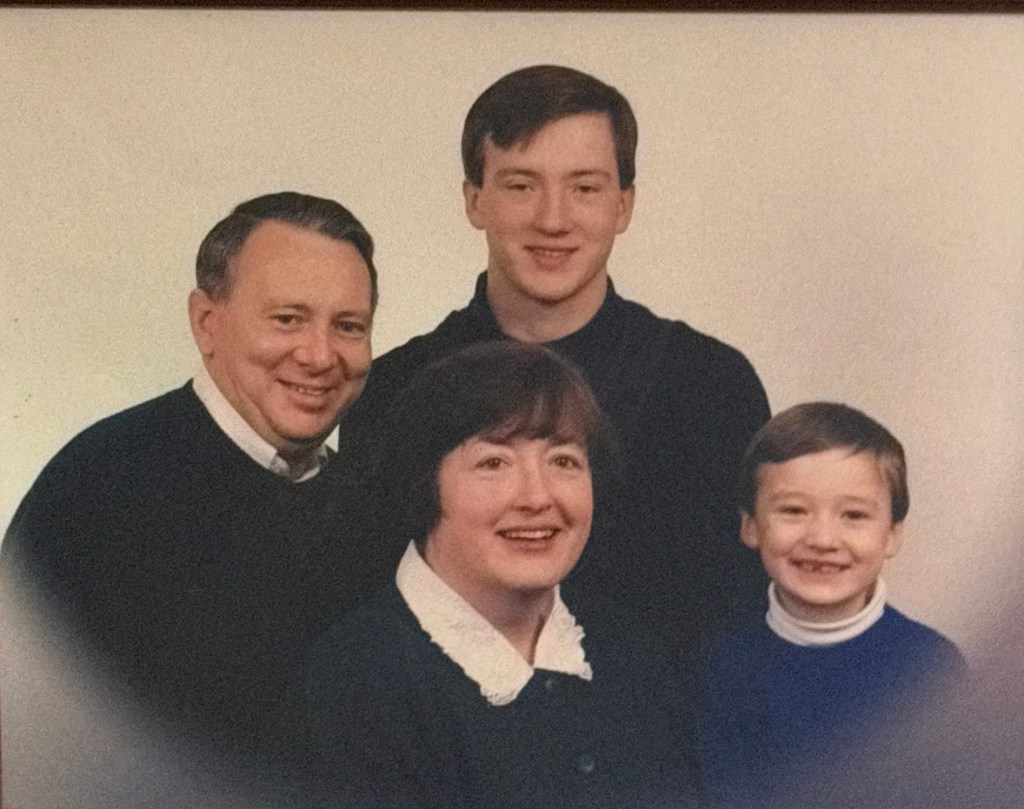
My grandfather, William Power, was a prominent ophthalmologist in New York City during the first part of the 20th century; his practice was located at 1 Wall Street in Manhattan. Yes, you read that correctly. His office was torn down to make way for a 654-foot-tall Art Deco skyscraper which is now a landmark in the city; the building brags white-glove service and currently includes a Whole Foods, the only American location of the French department store Printemps, and hundreds of condominiums and apartments, most of which are unoccupied (probably because one-bedrooms start at $995,000 after a remodel occurred before and during COVID, when people began moving out of the city due to the ability to work from home).
My Dad told me stories that his father shared with him about his life in the city during the early 1900s. One of note was that he was a member of an exclusive social club in Manhattan with members that included Teddy Roosevelt (yes, him), who he said was one of his favorite people to play cards with.
He found his first wife, Esther Jean Redmond, on his way home from doing a medical residency in Austria; my grandfather had stopped in Ireland on the way home, met her, married her, and brought her back to New York with him. She was the daughter of John Redmond, a prominent Irish politician during the final years of the British rule of what is now the Republic of Ireland.
Reading this all, I guess he was a heck of a baller way back then.
My grandfather and his first wife had four kids, but she ended up dying from some postpartum disease (it was never totally clear to me what it was) in 1917. Like most male professionals of that era, if their wife passed away, they remarried, rather than live their later years alone. He met my grandmother, a graduate of Fordham University with a doctorate in biology; in those days, being a female possessing their doctorate was extremely rare and remarkable. They married and had three children together. My father and his twin brother Joseph were born on December 9th, 1943; my grandfather was 65 at this point. Joseph passed away within days, but Dad made it through. His sister, Helen, was born on December 14th, 1944.
Dad spent most of his younger days living in the New York metropolitan area – first in a hamlet in Nassau County called Baldwin, then in Ho-Ho-Kus, which is about 30 minutes outside of the city in New Jersey. As my Dad progressed into his teens, the family moved to Angelica, a Western New York village with approximately the same population as modern-day 1 Wall Street, even with its current 20% occupancy rate.
Despite my grandfather’s social prominence during his younger years, my father did not grow up in wealth; they were not without, but my grandfather managed to well outlive his retirement savings. My father, as a result, often spent a lot of time working jobs around the community to make it all work. He delivered papers and spent summers trimming Christmas trees, baling and stacking hay, and helping out anyone he could just to collect a few dollars. In his high school years, he made the daily trek (before the days of Interstate 86) from Angelica to Olean to attend Archbishop Walsh, the new Catholic High School in Olean, where his mother taught biology to a whole group of his contemporaries that have shared their experiences with her to me over the years. He was a part of the first graduating class at the school in 1961.
Dad then attended St. Bonaventure University as a biology major. He was very academically focused and a commuter; therefore, he never had the insane stories you may hear from some Bonalums. Instead, he was worried about getting through three afternoons of labs a week, then getting home with his mom and sister to Angelica to grind away at making money and maintaining quality grades in a rigorous academic discipline. He graduated in 1965 and soon settled into a job at the Cattaraugus County Health Department in their Environmental Health unit.
My maternal grandmother started working as a nurse at the Health Department around the same time. My mom’s father had passed away that spring, and my grandmother went to work to make ends meet for her children. My Dad actually knew her three youngest daughters well beforehand – they all graduated from Walsh after him, and knew him either as an upperclassman to them or as his mother’s son. My aunts have shared some funny stories about their time at Walsh, including those that included taking classes with my grandmother – things such as being a little too forceful in cutting open frogs she was about to dissect, causing the guts to inevitably spill out, that she’d then shove back in nonchalantly with her fingers; or days where she would wear two different-colored shoes (which my grandmother would blame on getting dressed in the dark). They also knew my Dad’s sister, who was at Walsh during their time there. Even though they were amused and would joke about my grandmother, they saw my father as a very gentle and friendly man, and have always treated him with care.
Dad and my mother met when she came to work at the Health Department in September 1968. He had been working there for three years at that point, while she was coming back to the Southern Tier (she’s from Great Valley) after working at Mercy Hospital in South Buffalo in the Coronary Care and Emergency Units. She remembers being introduced to him in the foyer of the Health Department, which at that time was located in what is now known in Olean as the Bartlett House on Laurens Street. Obviously, he made an impression on her. They started dating within a year, and they got married on November 25th, 1972.
(Interestingly enough, I met Kim within my first four months of working in Allegany County through our work. It’s funny how history repeats itself, even when there is no intention in how it happens.)
Of course, wedding days are supposed to be as joyous as they come – they’re meant to be the next big step in your life. Unfortunately, that was not the case for Dad. His father had passed away the day before, that year’s Black Friday. My mom felt my father was a lot like my grandfather in terms of his demeanor, friendly and soft-spoken; she said it was a particularly hard loss on my father, as my dad looked up to him. Nonetheless, you can see in their wedding pictures that Dad still felt blessed being in that moment, despite dealing with tremendous grief at the same time.
My parents settled into a home on Washington Street in Olean across from Oak Hill Park for the first couple years of their marriage. I was born on December 19th, 1976 at St. Francis Hospital in Olean, which stood in a place that is now a lot for used cars and sheds on West State Street. However, it was once again not all joy at that time for Dad; my grandmother was a floor below the maternity ward on her deathbed. She passed away on the 21st, and he buried her before bringing my mom and I home on Christmas Day.
The three of us moved into my grandmother’s house on Brookview Avenue in Olean in January 1977, which is the family homestead to this day.
My Dad was extremely dedicated to our core family; I think a lot of my mentality about what matters in life is based on what I saw from him. He went into work early so he could be the first one home at night; he was not one to hang around the office past quitting time, because the job was a means to an end – taking care of the people he loved in every way possible. My parents also carefully vetted a babysitter to watch me at home when my mom went back to work after being home with me for a year; they found Theresa Childs, who was a huge influence in helping me develop appropriately and essentially became an extension of their care.
I remember him sitting in the living room and reading the newspaper, at night, which I would inevitably knock out of the way with force to get to his lap so I could sit there with him. He told me that I was one to sit on his lap from a very young age, even to the point where I sat on his lap one night and managed to accidentally give him two black eyes within an hour by suddenly throwing my head backwards. (Not surprised; I have a massive head.) We would watch the news on WKBW every night during the 6 PM hour; I would ask him about why they reported on the tides during the local weather (it was for the fishermen who went out on Lake Erie) and would get excited to see the movement on the Dow Jones Industrial Average during ABC News Tonight (I remember the first time it cracked 1,000, which is like a three-day gain at this point).
Dad was the one who got the morning going for me. He would get me moving every morning, make me a pair of toaster waffles, and carefully put syrup in every manufactured grillmark. (When we’d go out to eat during his later years, my wife and kids always marveled at the care he took in making sure every bite of pancake he enjoyed had an even amount of maple syrup and butter.) He then walked me around the corner to St. John’s, getting me there inevitably with about five minutes to spare before the bell rang to command us to get inside to start the day.
My Dad has always presented as very mellow, but there was a competitive side that would come out every now and then. My parents got me an Atari 2600 when I was four; the recommended age was 10 and up, but after watching me be intrigued with it by my cousins, who were mostly in their teens at that point, he and mom decided to let me have a go with it. One night after the news, he agreed to play one two-player game of Asteroids with me, which went one player at a time, rather than having us play simultaneously. We finished that one game somewhere around 10:15 PM that night, with him finally getting the best of me. (Luckily, it was not a school night, or he would have shut it down well before.) We’d sometimes go out back and play soccer against one another; he would let me compete but never let me win intentionally, which ultimately fueled me to be a better player.
Dad also spent a lot of years coaching my soccer teams as a child. He made it a point to go and get his coaching license so that he could be the best coach possible; he did that for us (my brother Pat and I), not for himself, as he had no aspirations of coaching anywhere beyond the sideline our bench was planted on. He valued teaching more than wins during his time as a rec league soccer coach; he understood his job was to grow players, not getting short-term wins. Of course, he often ended up winning plenty as time went on because of his teachings with kids. Sometimes, we’d sit way too much time listening to him, and all of the grass where we sat would inevitably be pulled up because we were trying to amuse ourselves; but his intentions were good, and everyone understood that, so no one was over-the-top obnoxious.
As coach, he made sure he had two coolers for the team for every game and practice – one filled with water, the other with the original lemon-lime Gatorade (my favorite flavor to this day). He’d get frustrated and repeatedly ask us to not open the top of the cooler to scoop out our drink, rather than do it the sanitary way of letting it pour from the spigot; a few kids would always do it anyway, he’d express his frustration, and the cycle would repeat itself again 20 minutes later at the next drink break. He showed enough patience to never go over-the-top in his exasperation with us, and he deserves a lot of credit for that.
My Dad may not have been a slave to his job, but he was very hard-working, knowledgeable, and respected for his abilities at the Health Department. He was involved in a lot of different things for the county, including the union, and actually spearheaded the work that created the county employees’ Federal Credit Union. He did a little bit of everything in environmental health – things that were far from glamorous but nonetheless essential to take care of the public. He was involved in doing a ton of food and property inspections; sending heads of dead animals to Albany to have them tested for rabies; helping to coordinate and work at rabies vaccination clinics throughout Cattaraugus County; and, most prominently, running the mosquito control program.
The mosquito control thing was always interesting. In the 1980s, there was a huge push by some environmentally-conscious residents to end the county’s mosquito control program, which involved aerial spraying of wetlands throughout the county. People had a serious beef with the process – they worried that the county was using pesticides that were harmful to all living things, humans, animals, and other insect species, specifically bees. However, my Dad also worried about the greater impact of the spraying on the public; he had done his homework and had the county switched to using chemicals that harmed neither the water supply nor the other animal populations well before the protests started. His concern was the greater health of everyone, which is the exact purpose of a job like that. When he was delivering papers as a youth, he had seen people in Angelica that had come back from an overseas job in the tropics infected with malaria, stacked under five blankets and shivering in 90-degree weather; malaria is not an issue in Western New York, but at that time, deadly diseases like encephalitis were there in the mosquito population and were deadly. His experiences obviously impressed upon him, because he remained steadfast in continuing the program in the face of a lot of public criticism.
People would say awful things about him over his stance; there were times where the marquee of the Palace downtown (when that was standing) was used to suggest the county was going to wipe out life with the spraying operations. There were public protests and endless letters to the Olean Times Herald; the vocal opposition got their message out as often as possible. However, Dad was certain that the operations were safe.
Part of that was a very personal experience of the treatment. The county moved to larviciding (killing them before they are flying and biting) in the early 1990s as it evolved to be a more environmentally-safe way of controlling the population, as well as a better practical solution (after all, mosquitoes can’t breed if they can’t reach adulthood). In 1988, we took a trip up to the Tug Hill Plateau as part of a getaway trip; we spent a day meeting with the family that flew the planes, as they were suggesting they may want to talk about the evolution of the process. My Dad inquired about the larvicide as part of the meeting; they offered him a chance to check it out. He did so by standing in the field next to their runway; they flew one of the planes over him at about 35 feet and directly sprayed him with the larvicide (no joke, I watched this all happen, and as an 11-year-old, it was a little unnerving). He said afterwards that there was no smell, no weird taste in his mouth, and felt nothing from having it happen to him. Sure enough, the county converted to larvicide within a couple of years.
Eventually, the anti-spraying group developed enough of a coalition as well as the right allies to bring a lawsuit against the County Health Department to try and end the spraying operations. The anti-spraying group decided to call my father to the stand during the hearing, thinking they had a “gotcha” moment they could use to get their agenda met. My Dad was not the person to go after; he knew the work inside-out, and they ended up having their petition dismissed, in large part because of my father’s testimony. Within the next year, West Nile virus had spread to this country, and public opinion moved away from the anti-spraying sentiments.
My Dad and mom went back to graduate school at Alfred University when I was little and obtained master’s degrees in public administration. I remember going on-campus there on days where one had class and the other didn’t want to make the trip there alone, for one reason or another. Most prominently, I remember them walking for their graduation ceremony when I was like 4 or 5. That commitment to education and personal improvement impressed upon me, and even when I hated school, I always kept in the back of my mind that education was extremely important.
My father had put in for promotions in multiple instances at the Health Department. He had scored well on the civil service tests, and had interviews, but ultimately never got the job. I believe it was an issue of politics – not the red vs. blue brand, but instead the social side of things. My Dad was never a schmoozer; he was always polite and friendly, but he was also reserved and not one to go out on the town, nor a person that spent a lot of time telling people how amazing he was. He was the classic guy to put his nose to the grindstone and get the work done in a timely fashion. As unfortunate as it was that he never got to move forward, our family probably benefited by him staying put, because it meant not being pulled away from what he cared about most – being a part of his family.
My Dad always focused on what he believed was doing the right thing, even when it ultimately went against his best interests, and sometimes even his happiness. Many of us talk about the importance of doing the right thing; it is a sign of great integrity in a human being to actually execute that. I saw Dad do that repeatedly. He made sure Pat and I had a Catholic education, which he felt was the best path academically and spiritually for us; I know he went without a lot of things just to make sure we had that need met. He also squirrelled away money to make sure there was something there after he was no longer with us, and bless him for doing that. He had little things he’d purchase for himself that made him happy, like purchasing radar detectors for the car, even though he never went fast enough for most law enforcement to actually bother with pulling him over. Those rare splurges made him happy, and I’m glad he did that.
One of those splurges was an expensive stereo system, complete with a Technic turntable, big amplifier, and a complex equalizer. I would use it to listen to American Top 40 every Sunday morning after 8 AM Mass; he took it over for the afternoon, and would usually spin old country like Kris Kristofferson, Glen Campbell, and Roy Orbison. However, he also was a big fan of ABBA, well before it became cool to listen to them again. I must have heard their Greatest Hits album from beginning to end about 50 times during the mid-80s.
Dad was an extremely capable person at a wide variety of things, but he never made a big thing about who he was or what he could do. He was quiet and reserved in most situations; he instead focused on doing the work and getting the desired outcome. He had plenty of great qualities to sell himself; instead, he was happy to quietly get along with everyone and get things done.
Dad was in Tier 1 of the New York State Retirement System; if you ever worked in the system, you know that this was the class that got wonderful benefits; they’re now into Tier 6, where I’m pretty sure you have to pay the state to retire. (I kid; you just get nothing.) The state pushed to get as many Tier 1 employees out of the workforce as they could during 2000; they offered a buyout with some ridiculous benefits, mostly in the form of massive offers of enhanced service credits. Dad did the math, and he determined that with everything combined, he would be at about 41½ years of service with the payout, which equated to getting a pension that was 83% of his full salary; he figured it would take a long time to make up for that opportunity, and retired from the county at the end of 2000, even though I believe he was not ready to do so.
It took him a while, but he figured out the next thing to do with the next phase of his life – helping Archbishop Walsh survive. It started with him working as a long-term substitute for middle school science (technically, that was for Southern Tier Catholic, but the middle school students were housed at Walsh at that time); he then got more and more involved, joined the board, and quickly became its president. It was a tricky job during that period; at one point in early 2002, the diocese had decided they wanted to cut all funding to the school, which effectively would have been its demise. He and the business manager at that time went up to the Catholic Center in Buffalo, stood in front of the finance committee, and argued their way to keeping the funding stream open; Walsh survived as a viable entity until 2023, when the diocese decided to sell the building, even with a student population still existing in its hallways and putting no money of its own into the school. The school remains open, but is just a tiny entity with a couple dozen students at this point. My Dad spent seven years helping out at the school in one form or another; his financial gain from the work, besides the substitute pay he received before joining the board, was a desktop computer to do his work on at the school, and that stayed behind when his time was up. Dad never did anything like that for the money; instead, it was about looking out for others.
Dad has been a rock for my brother and I when we’ve faced significant struggles. Dad was far from a human services type of person – he was very worried for my long-term financial stability when I went into child welfare – but he always seemed to know the right tone to set when things were really tough. He is the rare person that is able to be comfortable with the silence that some people need during tough times – time that allows the person to work through their emotions without interference, all while providing the emotional support that the person needs. It’s a skill I’ve been struggling with lately, and I think it’s due to seeing what he has gone through recently; I’ve been more mindful of it the past few weeks because it’s an underrated skill in attending to others. He was able to maintain a compassionate tone during my hardest periods, even though he went through his own struggles during some of those periods. Once again, he put others’ needs ahead of his own, and I doubt I would have made it through to get to a stable place in my life if it weren’t for him.
He also was the one that was able to have tough conversations with just about anyone. In my maternal grandmother’s final hours, she brought him and my aunt Sharon in and asked them if she was terminal because she felt they could handle the discussion better than anyone else; they admitted to her that she was. Last week, while coming to see my father in the hospital, Sharon told me that my grandmother responded by pulling her oxygen tube from her nostrils, something she had worn for several years at all times, saying, “Well, I guess I don’t need this any more.” That was my grandmother for you – blunt and to the point. She was someone that he shook his head at times but also cared about deeply because she was a pillar in my mom’s life.
I met Kim in December 2007. Until her, he only seemed to think one of the girls I dated was worthy of my attention. He was not an openly affectionate person with others, but he liked Kim from the get-go, and made it clear that he thought she was right for me. He was usually spot-on with his assessment of others, and definitely was in this case; if he didn’t like the girl, he basically ignored any sentiment I would offer about her. Even though he has not been one to offer much about his emotions, I’ve seen him show great appreciation for her recently, and that means a lot to both her and I.
Things for my father started to become significantly complicated in 2009. He developed an infection in his gall bladder, which quickly became septic and required emergency surgery. He went into cardiac arrest on the operating table; they luckily helped him pull through, but he was never as healthy afterward. He spent five days in an induced coma in the ICU after the surgery; when he woke up, he wanted to watch his favorite cable news show that day, which aired on Sundays – only to find out from us it was Wednesday. He was able to make it home, but it took him a lot of work to get back into functioning shape, and the baseline was always lower afterwards.
The episode took a toll on his heart, but not all of what happened was negative. We weren’t the most open about our feelings for one another before, but after that occurred, we always said “I love you” at the close of our conversations. He was quick to hug me after my wedding ceremony, after the births of Ben and Ellie, and at my graduation from UB with my master’s in social work. He found pride in my brother and my accomplishments, and I find myself feeling the same way when my wife and kids are successful, as well.
He was always quick to help out with whatever I needed. My parents helped Kim and I with the down payment of our first house without our request, and had no expectation of us paying it back. They also provided some financial help while Kim was home with the kids during their first few years – again, just to take care of us. There was no need to do that, but they did it because they wanted the family to have the best life possible. He also would help with any fixer-upper jobs around the houses – something I am not very good at. Luckily, he saved the day on a few occasions – again, without any expectation of a return on that work.
He also was very conscious of making sure I was able to function in my life. He rarely called during the week, mostly because he knew that life was very busy, and he did not want to get in the way, even though that was never an issue. I always enjoyed our conversations, even if I thought it was nowhere near what I believed, or if I’d hear it a few times before, just because it was fun to see his eyes light up about something he cared about. He also would do little things to look out for me, including making suggestions about taking care of myself – even things like giving me the book “Honest Aging” for Christmas in 2024; I haven’t opened the book, but I love that he was looking out for my wellbeing. I sometimes rolled my eyes at his advice, not because of where he was coming from, but because I (like everyone else) get in my own way often.
His health began to significantly decline in 2018. His heart was getting progressively worse, and in February 2019, he went out to the Cleveland Clinic for the first of his two ablations. My family came along, recognizing that this was a serious procedure, and wanting to make sure that he had our support. At the same time, my father-in-law Jerry had gone to the hospital with an infection that was growing worse by the day; Dad told me, lying in his hospital bed a couple of hours after his procedure was successfully completed, that we needed to head out in the morning to make sure we were there for Jerry. It was another spot-on call, as Jerry ended up getting airlifted from Wellsville to Sayre, PA the morning we left, and he spent a month in the ICU there before passing. He easily could have asked us to stay, given he went through that; instead, he saw the importance of being there for someone else at their critical time instead, and, as often was the case, his senses were correct.
In the last few years, he became very cautious about maintaining his health, in large part because he wanted to be there to ensure that his family was going to end up okay when it was all said and done. About a decade ago, he stopped going to Mass in the winter because illness is more prominent during those months; eventually, he figured out that it was safer to not go altogether. Fortunately, there are plenty of ways to experience Mass online these days, and he still worshiped from home. My family and I went out to dinner on many Friday nights from when Kim first moved to Olean as a time to be together; that ended around the time of his first ablation, but we transitioned to meeting at my house for dinner, instead. By the time my kids began participating in theater in 2022, he was rarely leaving the house at all, and unfortunately never felt safe to see them perform live. Nonetheless, he was extremely proud that they were willing to put themselves out there like that.
As things have become more dire, I’ve heard as well as remembered more about all the great deeds he has done in his lifetime that he never talked about but nonetheless did to positively affect others’ lives. My maternal grandmother went on a cross-country trip with her good friend Gladys in the early 70s; my parents sent along money as they went along to make sure my grandmother never went without. He co-signed loans for close family friends to make sure they could get a vehicle when their credit was relatively nonexistent. He donated and gave time to causes that I never heard about beforehand. Once again, it was never about selling himself; it was about doing the right thing.
Dad never had a group of close friends, but those who really knew him cared about him deeply. In the last few years, my relatives on my mother’s side often asked about how he was doing before the conversation ever really got going, even when things between family members got tense, because they saw him for the good man he was. My aunts are genial and fun-loving, and would often offer lighthearted jokes, like the one Christmas when I was a kid where he was re-gifted a lump of coal as part of his gift from my aunt Linda (I can’t remember who she got it from the year before); he made use of it by burning the coal in his little stove in our garage, rather than doing what most in my family would do, which would be to re-gift it the following year. I know he would never do that because he wanted to be sensitive of other’s feelings, even if he was not a warm and fuzzy person to outsiders. He appreciated that my aunts looked out for him, and they appreciated that he looked out for my mom, my brother and I, as well as their families.
There was never a relationship with his half-siblings from his father’s first marriage, and at this point, they have all been dead for decades. He and his sister had a major falling out shortly after their mother’s passing, and I don’t have any memory of her until my cousin Bryan came to college at Bona’s in 1993. He reconciled with his sister at that time, and eventually they connected from time to time during their final years, often talking for a couple hours at a time over the phone, or she would come to visit Olean just to see him.
Dad’s heart problems became very bad in early 2025. He was still being seen at the Cleveland Clinic, and the doctor eventually decided in March that he needed a third ablation; however, they could not get him in for the procedure until October. He never made it out there. He ended up in the hospital and had a stay in the subacute rehab unit for seven weeks starting at the end of July due to a major infection in his left foot. He got back home in late September, but was in no way healthy enough to make the 3½ hour journey to Cleveland. They rescheduled him for April 2026, with the hopes he would be ready then. He was in the hospital when his sister passed on August 10th, 2025; he was unable to attend the funeral, but asked Pat and I to go in his stead, because he felt that was important.
Dad made it to my house one final time on Thanksgiving 2025. He sat at our dinner table the whole time, as he was extremely labored and unstable on his feet; he was able to be there for about three hours until he was too tired to make it any further. The effort was greatly appreciated by all of us, and we recognized how hard it had been.
In mid-January, he had to be taken back to the emergency room, this time by ambulance; when I made it there, he was greenish in color. They determined he had two ulcers in his stomach, which were not about to heal because he had been on blood thinners for years to avoid having a stroke. The doctors determined he had lost five pints of blood; considering we generally have around ten pints of blood in our body, it was fortunate he went to the hospital when he did. He had several blood transfusions to stabilize. They did a CAT scan and found he had a tumor on his spleen. He spent the next two months bouncing between the hospital and rehab, going through a cardioversion at one point (I can’t tell you how many times he has had them done over the past decade) because he was in tachycardia nonstop. They sent him home after two months when the insurance company determined that he was not going to progress any further with his rehabilitation.
Dad spent about ten days at home. He had a doctor’s appointment with his cardiologist on a Wednesday afternoon. He was absolutely unable to stand, let alone walk, at this point. Pat and I got him out of his bed, to the car and into it, back out of it at the Olean Medical Group, and did the inverse of that when his appointment was done. He was basically dead weight, unable to do anything at all to move around; the long hospital stays and progression of his illness made him unable to move more than rubbing his nose. He couldn’t even get his legs back onto the footrests of the wheelchair when they slipped off. He had bloodwork done as part of the appointment. The next morning, the doctor called my parents and told him he needed to go to the hospital, as his white blood cell count was more than twice above the normal range, suggesting he had an intense infection. When he got there, they determined he also had two blood clots – one in his lung, one in his leg – largely because he had gone off of the blood thinners at the time they were treating the ulcer.
These final days have been hard on him. During his previous time out of the home, he developed a pressure sore on his backside, and those never heal properly when you are positioned on it. His arms have been poked so many times that he looks like he has road rash on them. He stopped eating. His breathing has been extremely labored. He has slept almost constantly these last couple of weeks. He’s had the sacrament of Anointing of the Sick (which some refer to as Last Rites) about four times during this calendar year; the priest thinks he’s good to go at this point. The chaplain makes sure that Eucharist is offered every day; even in his final days at the hospital, they would give him an extremely tiny piece so he could experience the sacrament.
You never want someone you care about to suffer at the end. To that point, he’s been lucky to be at Olean General Hospital, which is often maligned for various reasons. It’s a small-town hospital in a mostly rural area; it’s hard enough to attract medical professionals to any place in the country at this point, and even harder in a community where pay is going to be lower because the population is shrinking. It may not be the best place out there for treatment, but I feel that when it comes to care, it has been absolutely wonderful. My mom and Dad agreed to transition to comfort care on April 14th; they’ve made sure he has been as comfortable as possible, and they’ve checked in on us, even though they are no longer focused on his recovery. They’ve kept the double-room to just him so we could have our privacy with him in these final days. The discharge planner has been wonderful in making sure that my parents did not deal with some of the stressors that can occur during these end-of-life situations. The direct care staff has even brought in a cart with coffee, hot water for tea, juices, and snacks to tide us over so we can be here as much as possible.
My mother has been here for my father constantly. It’s been 57 years, and they’ve been each other’s ride-or-die every step of the way since they partnered up. She’s literally spent 12 hours a day with him every day throughout his stays in the hospital and rehab facilities over the past year, no matter how exhausted she is; since the 14th, she spent every night in the hospital, and only leaves there when I’m there so he is not alone. It’s love at its most pure, and it’s a beautiful thing that most people rarely get to observe.
Patrick has been wonderful in caring for my father through these last years, as well. The two of them have shared a quiet understanding – a love that needs no words to acknowledge its presence. They have their differences, but that happens with family; the ultimate thing is that love exists regardless of the gaps that are there between two people. Dad has always been proud of him.
Dad has spent more time sleeping than awake, and understandably so – it’s as much as he can do to keep going, despite facing the inevitable head-on. When he has been awake, he barely speaks, often relying on nodding his head yes or no in ways that are barely perceptible unless you are paying close attention.
It’s been unusual to have things so quiet in his presence. Dad was always soft-spoken, but also hard of hearing as time went on; therefore, when I’d go to see him at their house, the television was often blaring, sometimes so loud that no one heard me knocking. There was a cognitive dissonance walking into the room at the hospital and having no machines beeping, no pumps running, and the television off – pleasant but still a bit surprising.
My mother’s sisters stopped in frequently to see him. My aunt Margaret read a prayer over him one day, a very emotional moment for everyone in the room. My mom did not cry; she said she’s already gotten all of her tears out having to see him go through everything he’s dealt with over the years – brave, but devastating in its own way. Another day, Linda and Sharon came in and we said a rosary together for him. My cousin Jen also stopped in a couple times and gave him attention. He may have been sleeping at times, but he never misses much; I’m sure he knows all the support he’s gotten in these final days.
This has been hard on my kids, in particular. Ben walked in on the night of the 15th and immediately had to leave because it was devastating for him to see. He needed a few minutes, but was able to recollect himself and see him; he even gave his grandfather his rosary – a wooden one that was definitely a Franciscian-inspired design. Ben wants my father buried with it, and we are going to make sure that happens. Ellie did not understand where things were at first; however, we explained during our dinner in the cafeteria that night how things were progressing, and it hit her like a ton of bricks. Ben came back to the room after dinner and started playing Dad ABBA off of Apple Music.
On the morning of the 16th, Dad opened his eyes at about 9 AM. This time, the kids were there, and he was able to focus on them for a bit, even nodding gently when I said something to him. Ben played him some more ABBA, and everyone took their turns holding his hand and telling him they loved him. He opened his eyes again around 6 PM that evening; everyone took the time to show him physical affection and tell him how they felt. He looked from side to side at everyone and again gently nodded at everyone.
I had a great moment on the 18th with him. Mom had gone home to take care of herself for a couple of hours, and it was just the two of us alone. In these final days, I have often ceded the two bedside chairs to my mother and brother; I have focused more on quality time than trying to be constantly looming over him. This period was as good as it gets. I talked with him about the contents of this post for obvious reasons. It allowed us to reminisce on the great things we had together. I told him how lucky I was to have had him, how much he’s meant to me, and how proud I was of him and all he did. We then sat there and I’d joke with him; he’d smile in a faint but noticeable way, which was either him having a good laugh or amusing me. It doesn’t matter – it was nice to see him smile despite all he has gone through and what he was facing head-on at that moment. It brought me peace, and it’s made these final days easier.
In the days at the hospital, he got a glimpse into where my world has been at. He’s heard my phone sound my email chime about 60 times per day (no exaggeration, that is a typical day at my job), but able to appreciate that ultimately, in those moments, he was the priority. He’s seen what the kids feel about him; he’s seen what I see in Kim – the constant support, the moments of unadulterated care she provides to our family. I know he appreciates when people can step aside and show him how much he matters, and he’s seen that from a lot of people in these final days.
To that, I’ve been very blessed to have the family and friends I have in my life. I’ve had friends check in on me as this has gone on to make sure I was doing okay, emphasizing the importance of self-care in this time. In the world of social work, we often preach the importance of it, but rarely take it to heart. I’ve made a conscious effort to do that, and made sure I took some time every now and then to get a nap in or to step out to spend time with the rest of the “Core 4”. My co-workers have been phenomenal.
Our agency is in the process of undergoing re-accrediation, with the on-site visits occurring during the week of the 27th – in other words, everyone’s putting the last-minute touches on a process that happens every four years and the agency spends months preparing for, making this an extremely stressful period. I’ve gotten no “we need you to do this” moments during this period, even though I’ve been the one to answer the big questions in some scenarios. My direct supervisor has been a major support. Our time working together spans back to my times at Allegany County, where she was my direct supervisor during my final four years there, and our relationship has evolved, but we are back together, working towards a common goal – giving kids all we can to have a chance to be successful in horrible circumstances. She’s covered everything, making sure my team has what it needs in my absence despite this moment in time. We are all very lucky to have her working alongside us. When I sent out the email letting everyone know I was going to be off for the time being, the people on my team reached out in one way or another to say “We’ve got this, you’re where you need to be” in one way or another. One co-worker would send occasional texts just letting me know she was thinking of me. Kim kept other people abreast of where things were at; no one has questioned my absence and all have sent well-wishes along. I am working in the right place.
On the 22nd, the attending doctor on the floor walked into the room and stated that plans needed to be made to have him transferred out – essentially, the “we need the bed for someone else” thing we face in our country. Honestly, I think we got grace as long as we did because they didn’t expect him to survive as long as he did, but my dad is a resilient (maybe even stubborn) man of Irish descent, and he’s persevered. The question at that point became whether he goes to a nursing home or home with hospice care. At first, there was a lot of discussion between mom and I about where dad should be; she then ran home to get Pat, and during that time where it was just the two of us, I asked him directly. In one of those rare moments where he mustered enough energy to speak, he clearly said “home” twice. When it matters that much to someone, you do it for them, no questions asked. The hospital made arrangements, and he was transported home on the 24th. I’m sure the ambulance ride was rough, but he was able to relax, almost as if it was what he needed. He was home, the menagerie of cats were there and happy to see him, and he could be in his peaceful place.
A lot of people choose to measure their success in tangible ways – money, career goals, material possessions. My dad checked those boxes in a lot of ways, but where he was clearly successful was in the way I feel is the most important of all, and that is by showing the people he loved how much they mattered to him. That is a legacy that doesn’t get dwarfed by anyone else’s work, and it doesn’t get ruined by time – it lives on in what those people do with their lives, even in those dark moments we all inevitably experience.
A perfect quote popped up on my feed on the 20th. Of course, the big event of the day is it being 4/20, where many in the world celebrate cannabis culture. The comedian Norm Macdonald, best known for his days on “Saturday Night Live” as the Weekend Update anchor that got fired for his constant OJ Simpson jokes, would riff during the later days of his career about Adolf Hitler; he was quick to counter 4/20 as being the day of Hitler’s birth. Modern music fans also recognize it as the day of Swedish DJ Avicii’s passing in 2018. I had remembrances pop up on my timeline on various social media sites that day; one of them included a quote from him that seemed apropos at this moment in time. “One day you’ll leave this world behind, so live a life you will remember.” I believe that my father did that, and I hope he recognizes that. I know there are things he feels he’s leaving hanging, but he did all he could, and that’s enough for everyone else. We’ve got it from here.
Ultimately, my worry going forward is not about him or myself. Dad will be in heaven. I’ve probably leaned a little too far into being a social worker; I have mostly intellectualized the situation at this point. There will be moments where it will be very painful, I’m sure, but I’m more focused at this point on the wellbeing of those around me – my mom, brother, wife and kids.
My Dad’s story in this world came to an end today, April 27th, 2026. I am glad I was a major part of his story, and extremely blessed he was a part of mine.


 The Power Blog
Leave a comment