One of the great national pastimes in this country is being an armchair general manager for the major professional sports teams. It’s gone on as long as I remember, back to when my cousins and uncles would talk about advantages and problems with how teams were built.
I think a lot of people would equate fantasy sports to living that out; to an extent, that is accurate, but fantasy leagues are dependent upon raw statistics, which don’t always tell the story. As analytical models have grown, people have embraced the idea that looking at how statistics occur (rather than the basic numbers themselves) tells a bigger story of how successful a team may be.
My favorite way to play armchair GM over time has been on video games. All of the video game series (usually put together by the fine folks at Electronic Arts) have a franchise mode where you get to not only play as the team, but to build the team over time through trades, drafting, and free agency. I would play as the Bills in Madden, building a superior team quarterbacked by JP Losman that would find a way to have eight straight undefeated seasons and perennially employed somewhere around 18 Pro-Bowlers. It made you feel like a genius, which is a great marketing tool, as I probably bought four versions of the game during the first decade of the 2000s.
However, most people prefer to focus on the athletes in the real world. I used to take the attitude that some guys in those GM jobs were bad at it, mostly because I had the attitude that those decisions can be made in vacuum and that we can see things others can’t. Sports-talk radio, blogs, and podcasts stay busy throughout the year guessing about how GMs might operate and what they should do. Bill Simmons, the founder and star of “The Ringer” website, is probably the most prominent person to make a career out of it. For example, I saw a reel on Instagram two weeks ago where a guy analyzed the hundreds of trade packages that Simmons had suggested on various media, and which came closest to the actual haul that Jon Horst, the Milwaukee Bucks GM, received for Giannis Antetokounmpo. I think the guy said that the number of packages Simmons had suggested that involved Giannis going to the Heat was somewhere around 150. Simmons has an estimated worth of $100 million; in a quick Google search, only one person in sports that has worked primarily as an executive – the Heat’s Pat Riley – is believed to have amassed a similar fortune in that role. Not a bad haul at guessing wildly about what other people will do.
I definitely have had that streak of second-guessing teams in my life. However, time has softened me. I think I’ve recognized that it’s a lot easier to get things wrong than it is to have everything go right. There are so many things we don’t know about how things are ultimately working. We have a lot more information about the behind-the-scenes action than we used to, but there are still a lot of different pressures (including ownership’s wishes) that go into decision-making.
The Knicks just won a title because, in part, they weren’t attracting the big-name free agents out there; the names that were floated as being headed there in 2019, Kevin Durant and Kyrie Irving, went across the river to Brooklyn. Durant wasn’t going to get a maximum salary deal from the Knicks because he was going to miss the first season of the contract due to a torn Achilles tendon, so he thumbed his nose at them, and Irving joined forces with him. It worked out for the Knicks; Durant and Irving won one playoff series in three postseason appearances before both were traded away at the deadline in 2023.
The Knicks did not build much of their championship team through their drafting. Jalen Brunson came in free agency in 2022, and the team got criticized roundly for that decision. Landry Shamet and Jordan Clarkson signed with the Knicks as free agents. Josh Hart and OG Anunoby came via trades where the Knicks gave up a player they drafted. Karl-Anthony Towns was also acquired via trade where the two main pieces traded away were free agent-signings. Jose Alvarado came to the Knicks in a similar way. Mikal Bridges came via a trade where the Knicks gave up four of their 1st-round picks as well as a protected 1st they had previously acquired from Milwaukee. (It’s fine to criticize that as an overpayment, but it helped them win a championship, so I’m fine with it.) Only two rotation players came via the draft: Mitchell Robinson and Miles “Deuce” McBride (he came in a draft-and-trade scenario with Oklahoma City).
It’s easy and yet pointless to spend time overanalyzing how teams decide to go about drafting. There are so many factors that go into making a draft pick work for a team – the fit into the team’s strategy and system; the development curve of the player; the patience of the team to allow a player to develop; the owner’s preferences; and, as much as anything, the intangibles of the player being drafted.
I know that most of the GMs in professional sports have been around thousands of players before landing in their position, and that any good one, regardless of their path to the job, has a bunch of skilled talent evaluators around them. However, it is always difficult to figure out the way the brain of a young athlete will develop; brain science has found that a human brain is not totally mature until a person is in their mid-20s, which is when most athletes are reaching their physical prime. There are a lot of things that GMs may not recognize in the player’s background that may end up affecting how they eventually perform.
We’re on the verge of the 2026 MLB Draft, and admittedly, I rarely remember anyone that gets drafted until years later, when they are a pro and their draft year is referenced. The average age a Major League Player makes their debut in the Show? 25.0 years, which is usually four to seven years after they signed their first contract.
Recently, we’ve begun to see the trend of guys making the big leagues within a year or two of being drafted; most recently, 20-year-old Pirates catcher Konnor Griffin has made his way into the majors. However, he’s one of only eight guys in the big leagues that are under 22.
MLB is generally the exception, compared to the other leagues. We just went through the fun of the NBA and NHL drafts in late June; we often see the top players selected playing the next season. Of course, the NFL draft has become a huge event, where cities basically shut down for three days so some 21-year-old from Old Dominion can have his moment in the middle of the 6th round on Day 3; for example, over 800,000 people attended this year’s draft in Pittsburgh.
People put hope in young athletes, most of which are too young to drink legally in the United States; when things don’t play out exactly the way they want them to, everyone talks about how the draft picks and the people that run the team are bums. However, it’s not always easy to project how players will adjust to a step up in competition.
The perfect example of that is the 2009 NBA Draft, which has its own lore. The top seven picks:
1. Blake Griffin, Los Angeles Clippers. Played college ball at Oklahoma. Missed his rookie season due to a post-dunk knee injury. After that, Rookie of the Year in 2010-2011, six-time All-Star, five appearances on one of the All-NBA teams, part of “Lob City”, and an iconic performance in the 2011 Slam Dunk contest. Career averages of 19.0 points and 8.0 rebounds.
2. Hasheem Thabeet, Memphis Grizzlies. Played at Connecticut. Career averages in five seasons: 10.5 minutes, 2.2 points.
3. James Harden, Oklahoma City Thunder. Played at Arizona State. 2018 NBA MVP. 11-time All-Star, 1st-Team All-NBA six times. Three-time scoring champion, two-time assists leader. NBA 75th Anniversary team. Career averages of 24.0 points and 7.3 assists. “The Beard”. Unfortunately, also seen as problematic. He’s been on five teams in the past six seasons, in part because he’s admitted he’s not going to try any longer in a couple of spots; also, he only has one NBA Finals appearance in 18 seasons, and that was as the sixth man and 3rd-best player on the Thunder.
4. Tyreke Evans, Sacramento Kings. Played at Memphis. 2009-2010 Rookie of the Year; he had a monster season, averaging 20.1 points, 5.3 rebounds, 5.8 assists, and 1.5 steals per game. The only players that had similar numbers as a rookie in NBA history? Oscar Robertson, Michael Jordan, and LeBron James. However, he was a flash in the pan, and the Kings never made the playoffs while he was their star.
5. Ricky Rubio, Minnesota Timberwolves. Played in the top league in Spain, and had been second in the league in assists as an 18-year-old the year before. Stayed in Spain for two more years before coming to the NBA in 2011-2012; 12 seasons, career averages of 10.8 points and 7.4 assists. A solid starter most of his career.
6. Jonny Flynn, Timberwolves. Syracuse. A Niagara Falls native. 163 career games over three seasons with three teams. 9.2 points, 3.9 assists.
7. Stephen Curry, Golden State Warriors. Two-time MVP. 12-time All-Star, four All-NBA 1st Team, two-time Sports Illustrated Sportsperson of the Year, two-time scoring champion, and four NBA titles as the go-to guy on the Warriors. (I know, Durant, yeah.) I could go on and on about him, but most notably, he’s revolutionized basketball as a whole with his shooting; he has shown that being open is better than being closer to the hoop. He’s arguably the best shooter ever and one of the top dozen players in league history.
It’s easy to get after the other five teams for their picks, with maybe the exception of the Thunder picking Harden, who ultimately had his best seasons in Houston; he was traded after refusing to sign a contract for $13 million per year (which would have slotted him around Nene and Kevin Martin for the 2012-13 season). However, it wasn’t clear at the time of that draft that Curry would be what he is today. Of the guys drafted before him, four played major-college basketball; Evans played at a mid-major monster in a league (Conference USA) that was consistently turning out stars at that time; and Rubio was a star as a teenager in a league of men.
Curry played for Davidson, which at that time was in the Southern Conference. His numbers were wild (28.6 points, 5.6 assists), but he played six games that year against the likes of Wofford, Furman, and the Citadel, and Davidson lost in the conference tournament semifinals that year. There are plenty of players who can put up huge numbers playing at the smaller mid-majors, but it doesn’t always mean their game will translate to being unstoppable in the NBA.
Everyone knocks the Wolves for selecting Flynn and Rubio rather than Curry, as all three are point guards, but none of these players are guaranteed to be stars. As former Buffalo Sabres coach Ted Nolan has often said, “Prospects can become suspects.” More often than not, that rings true.
That doesn’t stop anyone from having an opinion. This is courtesy of The Athletic after the draft this June:
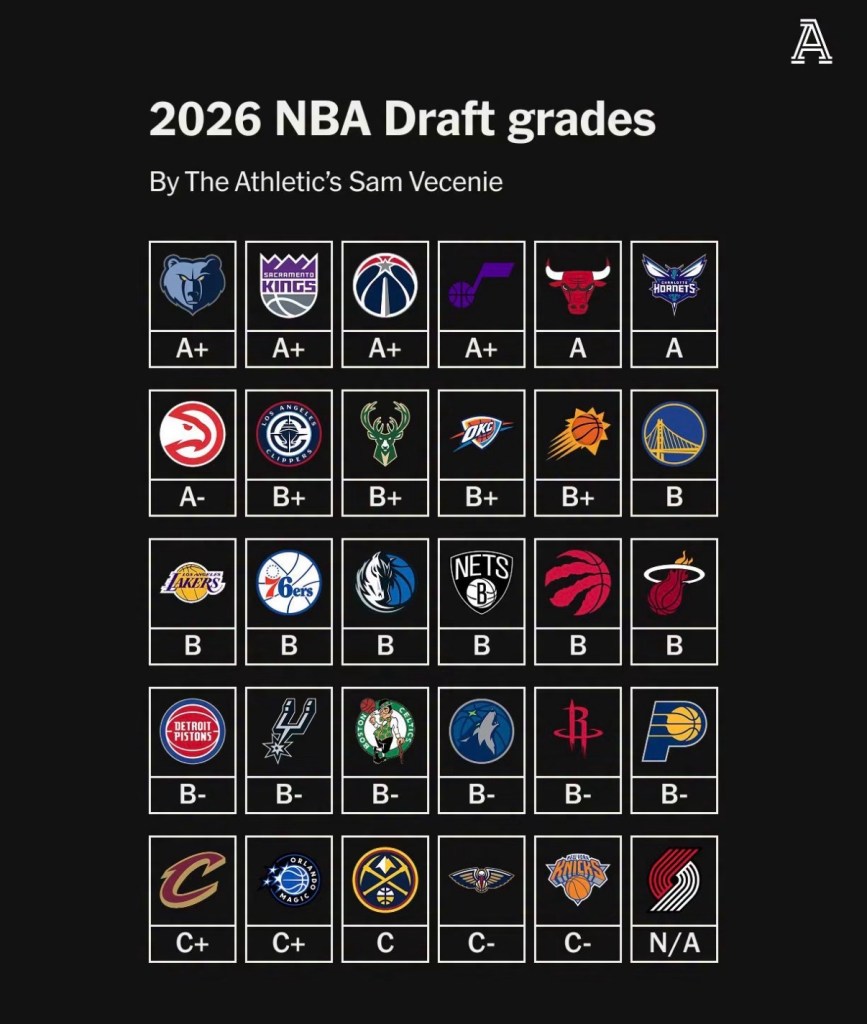
At the A+ end of the spectrum, three of the teams had the top three picks in the draft; the Sacramento Kings picked 7th. Meanwhile, the Knicks had two second-round picks, which in most cases are basically flyers on a player that might have some upside or give you some minutes off of the bench. Portland got no grade from the Athletic because they had no draft pick; ESPN decided that they instead deserved an F for trading away the two picks back in 2021.
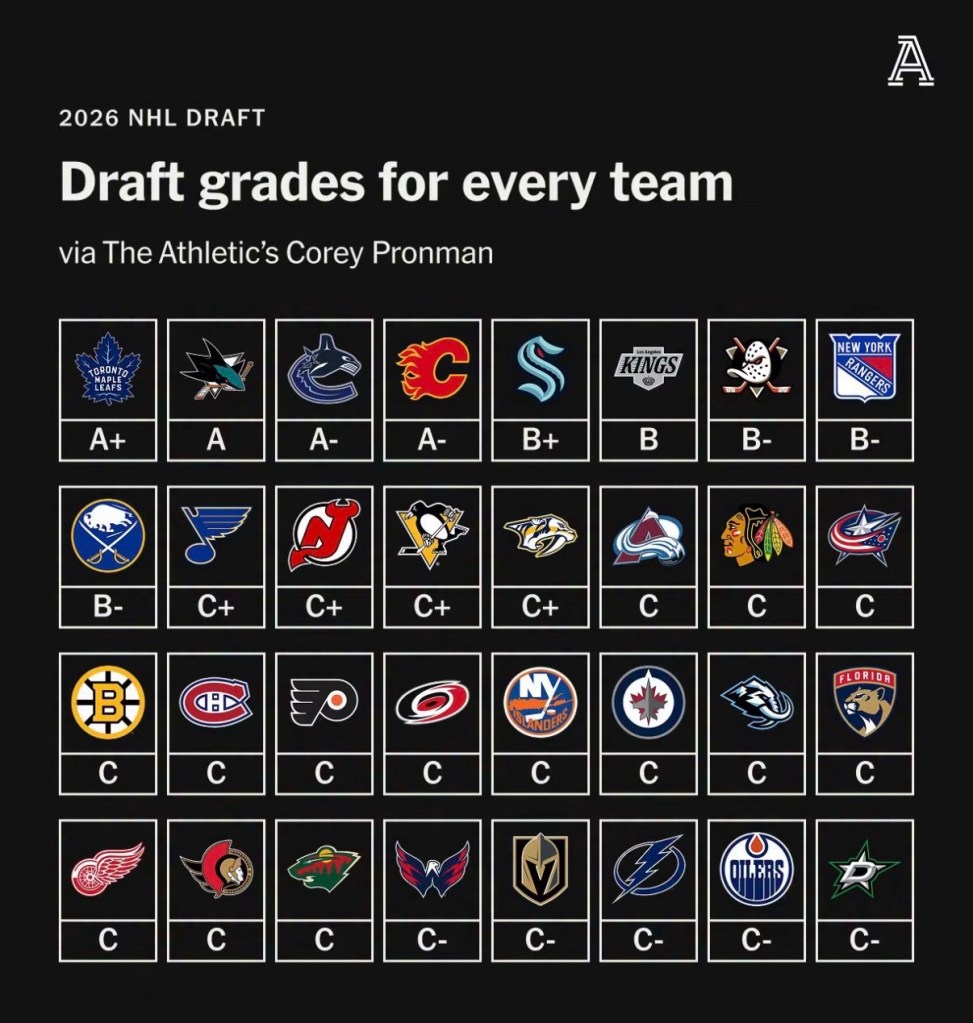
The NHL Draft rankings are much the same. Usually, the picks at the top of the draft end up being can’t-miss prospects, or, at the very least, All-Star caliber players. Take this past year: eight players scored more than 100 points. Seven were 1st round picks, and three of the top four scorers were picked 1st overall; the fourth, Nikita Kucherov, was a 2nd-round pick, and probably fell that far because he’s Russian. (Many Russian stars choose to play at home in the Kontinental Hockey League, so NHL teams are more cautious in drafting them). This year, Gavin McKenna was considered a superstar-level prospect; he was drafted 1st by… Toronto. I guess being awful makes it easier to nail your draft.
Part of the problem with assuming that these GMs are good and/or bad at their jobs is that it’s necessary to take a longitudinal view of their work, whereas their jobs don’t last nearly as long as it takes for the player to reach their peak. The average stay of an NBA and NFL GM is around three years. NHL GMs have their jobs for a shade under five years on average, while MLB GMs average about five-and-a-half years on the job. Almost all players reach their peak under a different GM and coach than the ones that were instrumental in them being drafted.
Sometimes, people look at picks in isolation rather than the grand scheme of things, as well. Take the 2017 NFL Draft. The Buffalo Bills had the 10th pick in the draft; they traded that pick to the Kansas City Chiefs, who took Patrick Mahomes. The Bills got the 27th pick that year from the Chiefs, where they took Tre’Davious White, who was a 1st-Team All-Pro before his career was derailed by a couple of leg (ACL, Achilles) injuries on turf fields. They got a 3rd-rounder that year as well, which they used to move up to take Zay Jones, not exactly a major success. Finally, they got KC’s 1st-rounder the next year, which they moved around to take Tremaine Edwards, who has been a Pro Bowler. Also, in 2018, they took Josh Allen, which softens the blow of not obtaining Mahomes.
Of course, the Allen pick is a case study in itself. Most Bills fans hated the pick; after all, he was a physical specimen but was, at best, an average quarterback at Wyoming, which is not in a Power 5 conference. Many preferred Josh Rosen, who had played at UCLA, a Power 5 school, and who had much gaudier numbers. The difference between the two was more than the sheer athleticism of Allen; it was a bunch of little things. Rosen did not adjust to learning NFL offenses quickly enough. The Cardinals, who picked Rosen, were impatient with him; in 2019, they had the top pick and took Kyler Murray and immediately made him the starter. Rosen is also not very mobile, and the NFL has migrated away from passers who strictly play in the pocket. Most importantly, Allen did something most professional athletes would never consider – he completely rebuilt his mechanics in the 2019 offseason to make himself the passer he is today.
The two passers taken in front of Allen in that draft were Baker Mayfield (1st) and Sam Darnold (3rd). Mayfield has been good but not elite; Darnold is much the same, but he won a Super Bowl with an extremely talented and well-coached Seattle Seahawks squad this past year. Notably, both have found their success after cycling through several teams, instead of in Cleveland and with the New York Jets, who are both seen as inept franchises. The fifth and final quarterback drafted in that 1st round? Lamar Jackson, two-time MVP.
With all that being said, I feel that there are a few times draft decisions were totally misguided. Though there are obvious ones following, I don’t see their mistake as an issue of talent evaluation as much as it was of philosophy. This isn’t the “I can’t believe you traded for Robert ‘Tractor’ Traylor instead of keeping the rights to Dirk Nowitzki” type of argument that involves a career to consider; this is more of a “you didn’t read the room” sort of mistake, which is infinitely more inexcusable in my mind.
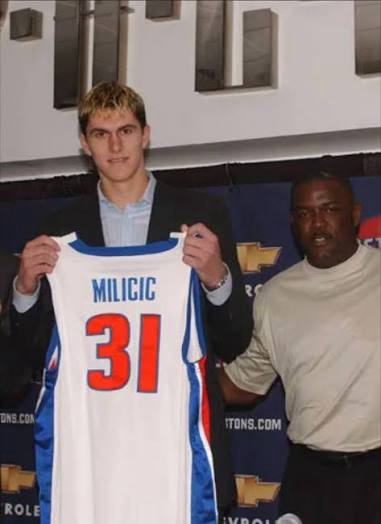
NBA: Detroit Pistons, Darko Milicic, 2nd Overall, 2003 Draft. The Pistons lucked out in getting this pick in the first place. They had the best record in the Eastern Conference the previous year, and only got the pick due to a 1997 trade with the Grizzlies (who were located in Vancouver at that time) where they gave up Otis Thorpe for a conditional 1st round pick; Thorpe averaged 11.2 points over 47 games for the Grizzlies before being traded to the Kings; that Vancouver team won 19 games that year. (However, the league was so bad that they only had the 5th-worst record in the league that year.) That pick had been lottery protected for five years before falling outside of the conditions (only the top pick would have allowed them to defer it that year). Had it been the top pick, the Grizzlies would have kept it, and maybe the franchise would have remained in Vancouver with LeBron there to sell tickets. (Of course, he could have easily refused to go there at all, too.)
LeBron was the easiest top pick to make in the history of the sport. However, this was a loaded draft. Picks #3, #4, and #5 were Carmelo Anthony, Dwyane Wade, and Chris Bosh, who are all now enshrined in the Naismith Hall of Fame. Those three, LeBron, and five other draft picks (Chris Kaman, David West, Josh Howard, Mo Williams, and Kyle Korver) made at least one All-Star game during their career.
Milicic was clearly a project coming into this draft. He had only briefly played in the top Serbian league as a 17-year-old; in fact, the NBA altered their draft rules just so Milicic would be old enough to be drafted in 2003. People had seen bits and pieces of his ability, and what they saw they liked. Meanwhile, Melo, Wade, and Bosh were more clearly known; they played at power conference schools during their brief periods in college and were All-American level players.
Milicic is not the first big guy to get drafted on potential; NBA teams are always looking for the next great paint protector, even as the last 45 years have shown that just as many title teams are led by perimeter players (Bird, Magic, Isiah, Jordan, Kobe, LeBron, Curry, and Brunson; even Nikola Jokic is not a traditional shot-blocking center).
However, your philosophy in drafting should depend on a lot of factors. Teams that are in building mode should always be weighing the ideas of draft-and-develop and “best player available”. The Pistons, on the other hand, were in their title window at that time. They knew that; otherwise they wouldn’t have hired Larry Brown as coach that offseason. Brown is a Hall-of-Fame coach that never lasted long anywhere he went, but won in his brief time at the helm in most of his 14 stops (including nine NBA teams and three major college programs).
Though the Pistons were good in 2002-2003, they were a flawed team, and in particular, they had a lot of trouble scoring. They were swept in the Conference Finals by a New Jersey Nets squad that had Jason Kidd and a bunch of good-but-not-great players.
The Eastern Conference was very much in play at that time, as the talent in the conference was very poor compared to the West; a major talent infusion would have easily propelled them to be at the head of the class for a long time.
The team thrived on defense during an era where most offenses in the league were not very good. They had Ben Wallace at center, who would win the NBA Defensive Player of the Year four times between 2002-06 (oddly enough, the 2003-04 season was the only season he didn’t win in that run). He is one of only three players to win the award four times, with the others being Dikembe Mutombo and Rudy Gobert. The Pistons were built on accentuating Wallace’s defensive capabilities. However, scoring was at a premium. Richard Hamilton led the way with 19.9 points per game the previous year, and Chauncey Billups was second at 16.5; after that, scoring was minimal. The old adage of “defense wins championships” has validity, but you still have to score more points than the opponent to win.
I think people like to picture that team with Melo or Wade, but I don’t know that either of them would have been as good of a fit for the team as Bosh, even though he may be the least prolific of the group. Melo had just come off of an NCAA Championship at Syracuse, and in most years, he would have been a no-brainer as the top pick. However, this was not going to be his team any time soon. Brown was notoriously tough, especially on young players, and Wallace and Billups would have set the tone; throughout his career, Melo always seemed to be only interested in being the alpha dog, and that mentality would have been bad for team chemistry. Wade was great, and would have been a boon to team chemistry, but they still would have lacked a frontcourt presence, and it would have meant their two best offensive players filled the same role, which ultimately didn’t fix the issue at hand. Bosh proved during his career he could find a way to thrive regardless of where he fit in the pecking order; he was excellent as the man in Toronto (five straight seasons averaging at least 22 points and 8.7 rebounds) and also thrived as the clear #3 guy in Miami. He also provided low-post scoring, which that team clearly felt they needed, because they dealt for Rasheed Wallace at the trade deadline; the Pistons gave up two 1st rounders, Chucky Atkins, and a bunch of guys averaging three points per game to get Wallace, who essentially forced his way to Detroit.
Yes, they won the title in 2003-2004 even though Milicic did not meaningfully contribute to that team then or ever. People discount some titles compared to others, and I think that Pistons team unfairly falls into that category. That year:
– The Indiana Pacers had the best record in the league that year (61-21), while the fourth seed in the conference, the Miami Heat, went 42-40; in fact, the only teams with good enough records in the East to make the playoffs in the west were the Pacers, Pistons, and Nets.
– The Dallas Mavericks were the highest scoring team in the NBA that season, averaging 105.2 points; the stars were Dirk Nowitzki, Steve Nash, Michael Finley, Antoine Walker, and Antwan Jamison – in other words, a lot of great offensive talent. The Kings were the only other team to average over 100 points per game. The 2025-26 season? The Nets averaged 105.9 points, which was 4.7 points per game fewer than any other team in the league. I definitely prefer the game today.
– Sam Cassell was one of the guards on the All-NBA 2nd Team. The 3rd Team guards? Michael Redd and Baron Davis. I don’t know if any of their career years would resonate in today’s league.
– The Lakers, the Pistons opponent in the Finals, were supremely talented, but they were also the best example I can think of when it comes to lacking chemistry.
The 2003-04 Lakers are the ultimate example of why money and talent are not the only things you need to win titles. Everyone knew that Shaq and Kobe already despised each other for numerous on- and off-court reasons, with the biggest factor being that neither of them was willing to let the other be the team’s alpha player. I’d argue that Shaq was that player in their three title runs from 2000-02; by 2003-04, Kobe was in his prime, so it was already murky. The team’s GM, Mitch Kupchak, had been worried about the team’s talent level; he brought in Karl Malone and Gary Payton in the 2003 offseason to see if that would help. They are both Hall of Famers and Top-75 players in the history of the league; they were also the unquestioned team leaders of their respective franchises (Utah and Seattle) for years before going to L.A.
One of the clichés thrown around in football is “if you have two starting quarterbacks, you really have no starting quarterback”; the point is that each team needs an unquestioned leader. Adding Malone and Payton essentially made the Lakers a team where four players saw themselves as the player worthy of leading the way. On top of it, you had four guys that didn’t really mesh with each other, either. Shaq is fun on television, but he had been the centerpiece of that team for years and was not going to give that up easily. Kobe did everything he could to emulate Jordan, including being a ruthless teammate. Payton was a world-class trash-talker that rarely turned it off, including with his own teammates. Malone was the second-leading scorer of all-time at that point, and wasn’t about to sublimate his game, either.
In the end, the team was generally miserable. Malone was injured during the Finals, and the Shaq-Kobe feud was beyond safe for anyone to handle. Pistons won in five.
Shaq and Payton got dealt to Miami in the offseason, where they’d win a title two years later with Wade as the centerpiece. Malone was injured and intentionally sat out the beginning of the next season, with the plan to sign with the Lakers once he recovered; he wanted to play with Kobe again, as the two had a very close relationship at that time. Then things changed. He wore a cowboy hat to a regular season game in 2004, and when Vanessa Bryant saw him, she asked him if he was hunting; he responded that he was “hunting for little Mexican girls.” That was it for Malone’s career. Kobe and the Lakers missed the playoffs altogether.
The Pistons made the Finals the next year, losing to the Spurs in seven. They made two straight conference finals after that. Still a phenomenal run, but not getting an immediate-impact player may have cost them another title or two.
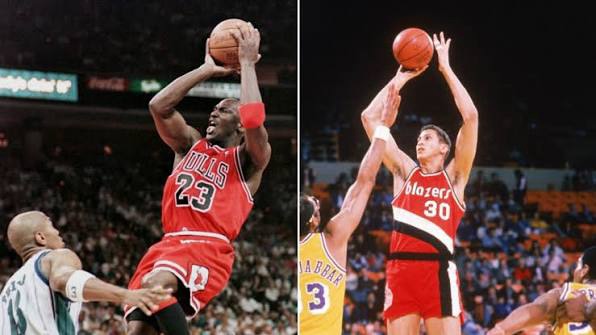
NBA: Portland Trail Blazers, Sam Bowie, 2nd Overall, 1984 Draft. We all know that Jordan was the next pick. It’s not that.
There were 23 teams in the NBA at that time including teams in Seattle and Kansas City (the Kings, for those not old enough to remember). The top eight teams in each conference made the playoffs, which translates to about 70% of the league making the postseason. Therefore, it wasn’t hard to get back into the playoff race if you had a high draft pick, and sometimes, even if you didn’t have one. Take the 1985-86 Bulls. Jordan broke his foot and played in only 18 games; the team went 30-52. They still made the playoffs despite having the 4th-worst record in the league because the three teams worse than them were in the East. Jordan was healthy for the postseason; he put up his iconic 63-point effort in Game 2 against the Celtics.
However, that series explains a different reality about the NBA at that time – it was extremely top-heavy. The Celtics swept that series against the Bulls, even with Jordan putting up the 63 plus another 49-point game. There is a lot of parity in the league today; I could have seen any of seven teams finding a way to win the title this year (the Knicks, Celtics, Pistons, and Cavs in the East; the Spurs, Thunder, and Nuggets in the West). In the 1980s, it always felt like there were only four or five good teams in the league altogether, and only five teams in the league (the Celtics, Lakers, 76ers, Pistons, and Rockets) made the Finals at all during the entire decade.
The Blazers (like the 2003 Pistons) were another one of those teams that lucked into a great draft pick, and, in that draft. They had the second-best record in the West that season (which was 47-35, further emphasizing my point on the imbalance of talent), but they lost in the first round of the playoffs to the Suns. They had traded Tom Owens (I did not make him up) in June 1981 for the Pacers’ 1st rounder in 1984; the Pacers had the worst record in the East all three seasons between the trade and that draft. Voila – the Blazers were picking at #2 because they gave up their seventh-leading scorer three years before.
In retrospect, most people think that the Blazers didn’t select Jordan in part because Portland already had Drexler. That probably was not the case. People knew that he was talented, but Drexler was the eighth man in the rotation as a rookie that year, averaging 7.7 points per game. He didn’t see a lot of time playing behind Jim Paxson, who, in his age-26 season, was 2nd Team All-NBA in 1983-84. That may sound ridiculous, because I think most people would relate him to his brother John, the solid but unspectacular role player for the first three Bulls championship teams of the early 90s, but once again, I did not make that one up.
What was ultimately odd is that the Blazers weren’t even attacking a gaping hole in their roster by drafting Bowie. Their starting center in the 1983-84 season was Mychal Thompson (Klay’s dad), a dependable defensive player who averaged 15.7 points and 8.7 rebounds in his age-29 season. Thompson was never an All-Star, but actually had a good run as the Blazers center before being a dependable backup for the Lakers on two championship teams in the late 80s.
It seems as if the Blazers didn’t consider the idea of bringing in Jordan and moving another piece around. Drexler stood 6’7”; Jordan was 6’6”, as was Paxson. In the mid-80s, the average small forward stood at 6’7”. Slide Drexler to the 3 spot, and you’ve solved the lineup issue; you can rotate having all three on the floor. Paxson, mind you, fell out of the lineup pretty quickly after that 1983-84 season; by 1985-86, he was coming off the bench, and was essentially a role player there and in Boston for the rest of his career. Drexler was a capable defender, and he showed he could sublimate his game and be effective without being the go-to guy during both of his instances in Houston (college and pro).
Often, the best player available is the best way to go. That year, the Rockets had the #1 pick in the draft after a 29-53 season. They took Hakeem Olajuwon (who at that time lacked an “H” in his first name) with the top pick. The Rockets best player going into that draft was Ralph Sampson, a 7’4” center coming off winning Rookie of the Year. Yes, they doubled down on the same position, creating that brief “Twin Towers” era before Sampson’s knees would start to become a consistent problem in 1987. It got them to an NBA Finals in 1986, and Hakeem later won two titles with the Rockets (1994 and 1995).
The worst part is that the Blazers ownership and management knew that the “Best Player Available” mentality was sound. The 1977-78 NBA MVP was Bill Walton. Walton would quickly force his way out of Portland afterward because of frustrations he had with the team regarding their treatment of injured players, but before that all became public, Thompson was the top pick in that draft. The GM of the Blazers in 1984 was Stu Inman, who was one of the architects of the Blazers team that won a title back in Walton’s era.
Of course, if you want to play the “what if” drafting game with that 1978 pick, too… the Blazers glaring weakness going into that offseason was scoring, and Larry Bird did go #6 that year.
The “what if” game is easy when you work at it.
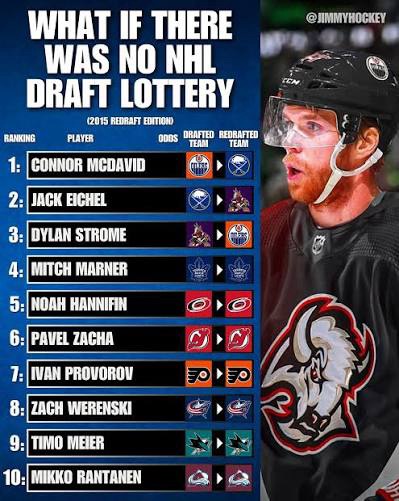
NHL: Buffalo Sabres, Jack Eichel, 2nd Overall, 2015 Draft. The pick was absolutely the right one. The entire execution around that pick was disastrous.
I feel that a majority of sports teams are doing the right thing when they are either clearly good or clearly bad. Middling it rarely gets most franchises anywhere.
Some teams don’t have to fret if they’re stuck in that no-man’s land of mediocrity. In baseball, the Yankees and Dodgers will spend the money to avoid being stuck in the middle forever. In basketball, the Lakers are always an attractive destination; the Celtics and Heat can also find their way into that conversation in most situations. In the NFL, teams become attractive (especially for offensive players) if they’ve got a great quarterback. In hockey, the Florida teams (the Panthers and Lightning) enjoy the advantage of warm weather and no state income tax; other teams like the Rangers, Maple Leafs, and Canadiens will rely on tradition to convince some guys to take a chance there.
The Sabres do not show up anywhere near that level for players looking for a new destination. Buffalo knows that too well. The issue during the Bills’ 17-year playoff drought was the example the Sabres should have known – after all, Pegula was the Sabres’ and Bills’ owner at that point. The Bills never had multiple stand-out players at any one time during the drought; also, they were never bad enough to get a great draft pick or good enough to challenge for a playoff spot. Instead, it was “the heroic march to 7-9”, which is essentially going nowhere.
Pegula had bought into the concept of being either really good or really bad a couple of years before, particularly when Tim Murray became GM of the Sabres. I think that after getting burned a couple of times in free agency, he recognized that “Hockey Heaven” was something people had to discover on their own, rather than having it sold to them. After all, most players do seem to enjoy Buffalo as a community when they have a chance to settle in, but it is not an easy sell to someone unfamiliar with the area.
I already wrote about the Sabres’ drought in a three-part, 20,000-word diatribe. The Eichel draft is in the beginning of Part 2 found here.
The issue was the way the Sabres got to the point to pick Eichel. The roster had a nonexistent amount of talent going into the previous trade deadline, as Murray had traded anyone that was replacement-level or better beforehand to make sure the team was awful. Also, the team already had some cracks in their developmental talent that was already in Buffalo (oh, Rasmus Ristolainen, we will never forget you). Very few of the prospects in the system were anywhere close to being NHL-ready.
Eichel was already a top-two-line caliber center coming out of college. The team didn’t have any other top-six forward players on the roster. Coming off of a historically bad season, there was no way the Sabres were attracting top-tier talent. Therefore, the team had to trade for established players to match the talents of their new star.
The way they did that? They traded away most of the prospects that they had acquired during the tank that were supposed to flourish just as Eichel started to become a great player.
Worst of all, the guys they acquired already had reputations for being problematic in their old cities.
– Robin Lehner had already shown a bunch of erratic behavior in Ottawa, which it turned out was likely related to struggles with Bipolar I Disorder, PTSD, and an alcohol use disorder. Mental health is not something I take lightly; I definitely feel for anyone that struggles with substance, mood, or trauma disorders, let alone all three. None of them define who they are. However, Murray was well-connected with Ottawa, having been the assistant GM when Lehner was drafted and five years of his development. He should have recognized that Lehner was struggling, and that bringing him to Buffalo and expecting him to “work through it” wasn’t going to work for anyone.
– Ryan O’Reilly was despised in the Colorado locker room towards the end of his time there after multiple disputes about minutes, money, and his attitude towards some of his teammates. The bad blood never disappeared with the Avs – he was still disparaging the team in 2021, even when there were only three players left from when he had been on the roster back then. Maybe Murray thought Buffalo would be a better fit, where he could run into a Tim Horton’s whenever he wanted.
– Evander Kane is a great story, but a terrible teammate. It’s detailed later in the Part 2 drought feature.
The Oilers, who won the lottery and got to pick Connor McDavid, were in a much different place. They had 62 points the previous season (compared to Buffalo’s 54), but there were a lot of talented pieces already on the roster, including Taylor Hall and Leon Draisaitl, both of whom would have MVP seasons later in their career. The Maple Leafs, also in the process of a rebuild, were already building through the draft, and never stripped the cupboards bare in doing so; they added Mitch Marner in that draft, Auston Matthews in the next one, and John Tavares in free agency the following year. Meanwhile, the Sabres signed Kyle Oposko, who was a legitimate star – only for him to begin having concussion problems during his first season in Buffalo.
Eichel has become a great two-way player and easily one of the best five players from that draft (Marner, Zach Werenski, and Kirill Kaprizov definitely belong in that conversation as well). It would be unfair to compare him to McDavid, but there was only a 20% chance that McDavid could have been a Sabre, so the expectation was unrealistic.
Eichel was never going to be that player in Buffalo, though. He walked in already anointed as the franchise’s player; it’s a lot to put on a player, and just as significantly, it puts him in complete control. He earned his keep, but no one could say no to him, because they gave up everything to get him. Tanking can work; “The Tank” was flawed from the beginning.
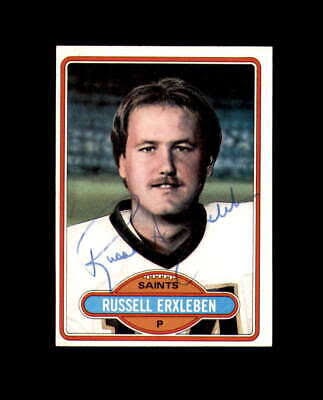
NFL: New Orleans Saints, Russell Erxleben, 11th Overall, 1979 Draft. Researching this one was rather captivating.
This draft had three Hall-of-Fame players: Kellen Winslow, easily one of the best tight ends to ever play the game; Dan Hampton, one of the key defensive cogs of the Chicago Bears’ “46” Defense in the mid-80s; and Joe Montana. Bill Cowher was also in that draft; his one fumble recovery and his tackle that broke Jeff Fisher’s leg weren’t enough to get him to Canton, so he had to win a Super Bowl and 149 games over 15 seasons to find his way to a bust there.
As for Erxleben:
– He had a medieval German surname easily recreated by smashing your hands in a specific way on your keyboard.
– He was a three-time All-American at Texas, the only person to ever achieve that feat at his position in NCAA history.
– He did it as a punter.
He was also a kicker; he hit 60% of his field goals and 92% of his extra-point attempts. He reportedly could kick harder than almost anyone that preceded him; in fact, he still holds the record for the longest field goal in NCAA history, at 67 yards. However, in that era, kickers were allowed to use tees in field goal attempts, and the ball was placed back at the line of scrimmage after a failed attempt. Now, both rules have changed, especially that the ball is now placed at the spot of the kick after a missed field goal; teams think much differently about trying as a result.
The NFL is the prime example in this world of how to overly examine a topic. It’s not just fans that pore over statistics for their fantasy draft that occurs in late February, before either free agency or the draft occurs. Teams go completely off the deep end. During the season, some coaches live at their facilities full-time because they have a mentality that taking the time to commute wastes precious moments that could be devoted to strategizing. Win or lose, the assistants are often drawing up game plans for next week before the locker room is cleared out after that week’s game, and sometimes, it seems that teams actually coach themselves out of playing well.
Yes, there are a lot of moving parts, and creating any possible advantage in a game where you only have 10-12 possessions is great. They say that inches matter in the NFL; creating any edge for yourself in a game where every moment is amplified is important, but sometimes you can miss the big point looking at the small stuff.
Free agency didn’t exist until 1993; if a team drafted or signed you, they held your rights as long as they wanted to. There was a lot of litigation through the courts that led to the world of NFL free agency that we see today, and it is part of the reason players now get paid big money – competition for their services is now allowed to occur.
As a result, the NFL draft held a unique importance, because you held power over the players you drafted. However, it was far from science. Almost every football game played on this planet is now on video. The thousands of pieces of tape and information available on every player today were not available in the 1970s; Mel Kiper Jr., now worth $7 million, was just 18 and five years away from signing a contract worth $400 (total) with ESPN to analyze the draft in 1979. Teams had scouts all over America, but there weren’t databases and moments to compare-and-contrast different athletes out there.
Being an All-American mattered more in those days than it does now. For example, Bishop Fitzgerald, a 1st-Team All-American safety at Southern Cal last year, went undrafted this year and signed with the Tennessee Titans. It’s one thing to put up gaudy numbers at Connecticut and make the All-American team, much like Bills 4th-Round pick Skyler Bell did; it’s another to be 1st-Team All-Big Ten and not get selected at all.
The kicking game was starting to be seen as increasingly important in the league during the 1970s. Ray Guy, the Raiders’ Hall-of-Fame punter, was a 1st-round pick in 1973, and he was the punter that brought the concepts of “coffin corner” and “hang time” to the conversation. Guy had spent the first six years of his career as a 1st-Team All-Pro by the time the 1979 Draft occurred, and was seen as an important piece of the team, as his skill helped prop up an average defense by making the field longer for the opposition.
Erxleben never filled the role of Ray Guy, nor was he Mark Moseley, the NFC’s Pro-Bowl kicker that season that would eventually go on to win league MVP from some media outlets in 1982. (1982 was a strike year, and also at the beginning of crack becoming a major issue in America. Times were unprecedented.) In that era, the Raiders had loads of talent; the 1978 Raiders had nine Hall of Famers (including Guy) on the squad. They also had a Hall of Fame head coach in John Madden, and followed him with another Hall of Famer, Tom Flores. Meanwhile, the Saints arguably had the most talent the franchise enjoyed during their first 12 seasons, which led them all the way to a 7-9 record. Their Pro Bowl quarterback, Archie Manning, was named NFC Player of the Year that season. The Manning family legacy was also nearly wiped out by the Saints, as Archie was sacked 340 times over his 12 years with the team, including a year (1976) where he missed the entire season due to right shoulder surgery. (Could you imagine if Tom Brady had never faced the Eli-led Giants in two Super Bowls or lost three AFC Championship games to Peyton?)
Erxleben was a unique example of a draft pick in many ways. There’s never been a punter drafted higher in the draft than him, and there is only one kicker that has been selected in the top 10 in the history of the draft. New Orleans decided that they might maximize the value of the pick by having Erxleben hold both kicking jobs.
All of it went poorly. In his first career game, in a 34-34 overtime game, he had a snap for a punt fly over his head and to the goal line; Erxleben scrambled back, picked up the ball, and managed to get off a chest pass that went directly to a Falcon, who calmly walked it into the end zone. Ball game. Erxleben pulled his groin in the next game and was placed on injured reserve for the rest of the season. The Saints still managed to have the first non-losing season in franchise history (8-8). In the 1980 season, Erxelben went 2-5 on field goals in the first two games, then decided he would strictly focus on punting going forward. He was unimpressive but stuck for five seasons before the team drafted his replacement and released him in 1984. He also made one punt in a non-strike game for the Lions in 1987, and that was it as an NFL player.
The problem in this example is that the Saints picked a person that primarily kicked a football. There have only been five players that held either position picked in the NFL’s 1st Round ever: Guy, Erxleben, Charlie Gogolak (1966, Washington), Steve Little (Cardinals, 1978), and Sebastian Janikowski (Raiders, 2000). The concept of drafting these positions is not something that most franchises do, and it rarely seems like it’s made by a sound football mind, with the drafting of Guy being the only possible exception. Washington drafted Gogolak in the midst of the longest playoff drought in NFL history (25 seasons). The only other team to go that long without a playoff berth? The Cardinals, who currently have the longest active championship drought of any team in the four major North American sports (79 years as of 2026). Al Davis was a great football mind, especially in the days of the AFL and in the first decade after the merger; however, he was 71 when he decided the Raiders would take Janikowski, and in the final eight years of his life, the team went 37-91.
The Saints are far from a storied franchise themselves. Yes, they won a Super Bowl in 2009, during the team’s best era, where they had Drew Brees at quarterback and Sean Payton as their head coach. They made the playoffs nine times during that pair’s 14 years together (2006-20, with Payton missing 2012 due to BountyGate), and the team never finished worse than 7-9 in any season at least one of them was with the team. The Saints also had a solid 10-season run with Jim Mora, who led them to the playoffs four times between 1986-95. In the other 41 seasons of the franchise, they’ve made the playoffs once – Jim Haslett’s Coach of the Year campaign in 2000.
Like I’ve said, this isn’t about the talent that’s picked; I originally was thinking about putting Guy in this spot until the research led me to Erxleben. Ultimately, the worst bang-for-the-buck in this draft was enjoyed by the Bills, who had the #1 pick that year as part of one of the wildest draft trees in NFL history.
– The 49ers received OJ Simpson from the Bills in 1978; he missed half the previous season due to injury after what may have been the best four-year run of any running back in NFL history, including the 2,003-yard season in 1973. The Bills got five picks: 2nd and 3rd rounders in 1978, 1st and 4th rounders in 1979, and a 2nd rounder in 1980. OJ had his two lowest yards-per-carry seasons during his time in San Francisco and then retired. Many Niners analysts consider it one of their worst trades in franchise history.
– The Bills selected Tom Cousineau, a two-time All-American linebacker from Ohio State, with that #1 pick in 1979. Cousineau never played a down for the Bills; the Montreal Alouettes of the Canadian Football League offered him twice what the Bills did, so he played up north for four years.
– Of the other four picks the Bills received, the most notable was running back Joe Cribbs, the 1980 2nd-rounder. He made three Pro Bowls with the Bills and won AFC Rookie of the Year in 1980; he also set the record for most fumbles by a non-quarterback in a season during that rookie campaign with 16. He had four solid years for the Bills.
– After his four years in Montreal, Cousineau decided he wanted to play in the NFL. He still refused to come to Buffalo, so they traded him to Cleveland for three draft picks, including the Browns’ 1st-rounder in 1983; the Bills used that pick to take Jim Kelly.
– Cousineau lasted three seasons in Cleveland and was a 2nd-Team All-Pro in 1983. In 1986, Cleveland brought in two new linebackers and Cousineau was released. Cousineau and his agent claimed that he was actually released because the team falsely believed that he was homosexual. The Browns’ owner, Art Modell (sorry, Cleveland), denied that.
– Kelly? He didn’t want to come to Buffalo either, so he skipped the 1983 NFL season and signed with the Houston Gamblers of the United States Football League. In his two USFL seasons, he won an MVP and threw for 9,842 yards, including one game where he outdueled Steve Young (of the LA Express) by throwing for 574 yards, which is the most anyone has ever thrown for in a professional game.
– Cribbs got into a contract dispute with the Bills after the 1983 season, so he went to play for the Birmingham Stallions in the USFL. (Birmingham was my favorite team in the league because of him.)
– After the 1985 USFL season, the Gamblers went out of business. The owner sold the team to Stephen Ross, a real estate developer that would end up taking over as owner of the Dolphins in 2008. Ross saw the team was not fiscally viable on its own, and instead tried moving them to New York City; he then settled on merging the team with the New Jersey Generals. Donald Trump had bought the Generals two years before, with the hope of forcing his way into owning an NFL franchise. As part of the plan, he wanted to build an 80,000-seat stadium in Manhattan. (It’s obvious what he planned on naming it.) He tried to face the NFL head-on, sued the league in an antitrust lawsuit… and won $3. That was the end of the USFL.
– It took eight years, but the Bills finally got their 1st-round pick from the series of trades to end up in Buffalo. In the end, Jim found living in Buffalo palatable, and the early 90s were the Bills’ heyday.
Erxleben has had a notable life after football. He became a financial investor in foreign exchange trading and built himself a Ponzi scheme that defrauded around 500 people out of nearly $35 million. That got him five years in federal prison and owing millions of dollars due to settling lawsuits. Unfortunately, when you’ve been convicted of managing a Ponzi scheme, the only thing you can get hired to do for a living is… to run another Ponzi scheme. Erxleben was caught again and spent another six years in federal prison. He decided to say in interviews that he views himself as a victim rather than a conman. In related news, Hades is looking forward to eventually starting another Ponzi scheme with Erxleben on the other side of the river Styx.
NFL: St. Louis Rams, Lawrence Phillips, 6th Overall, 1996 Draft. Let’s be real – the story of Lawrence Phillips is a tragedy.
Phillips did not have the ability to be safe for himself or others. At Nebraska, he was in trouble multiple times. It started with an incident in March 1994, during his freshman year at Lincoln; he was accused of grabbing another college student around the neck. He entered a pretrial diversion program, but failed to complete it by November; as a result of that, he was charged with assault, vandalism, and disturbing the peace. He was brought in to face the judge in early January 1995 – just two weeks after the 1994 NCAA season ended with Phillips earning 2nd-Team All-American honors, and Nebraska winning the National Championship.
Phillips got into major trouble in September 1995 when he scaled an apartment building in Lincoln to break into then-backup quarterback Scott Frost’s apartment through a sliding door; he went there to confront his ex-girlfriend, and did so violently. He dragged the ex-girlfriend out of the apartment by the hair and then all the way down to the ground floor; he finished things off by smashing her head into a mailbox. He was again arrested and charged; head coach Tom Osborne suspended Phillips for six games, despite the faculty pushing for Phillips to be expelled.
After a six-game suspension, Osborne brought Phillips back, but the coach made Phillips the backup behind Ahman Green, who eventually ended up rushing for 9,208 yards in his NFL career. For that year’s National Championship Game, Phillips started and the Huskers blew out Florida. Osborne encouraged Phillips to turn pro after the season, so that’s how Phillips ended up available for the 1996 Draft.
Phillips was ultimately responsible for his own behavior; however, the people that were responsible for him during his upbringing did a poor job caring for him. Phillips, who grew up in Inglewood, California, was horribly abused by one of his mother’s live-in ex-boyfriends; eventually, child welfare intervened, and Phillips was placed into foster care before his 12th birthday. Within two weeks of being placed in care, he was transferred to MacLaren’s Children’s Center, which was a temporary shelter for youths caught up in Los Angeles County’s juvenile justice system (aka a children’s home). MacLaren was not a place for children at all. It was notoriously overcrowded, dangerous, and it eventually came out that many of the youths there were sexually abused while at the facility. It was so bad that it was closed after a lawsuit by the national arm of the American Civil Liberties Union in 2003. In 2025, Los Angeles County settled a class-action lawsuit with 6,800 youths that had been placed in their care for $4 billion dollars. A majority of those youth had spent at least some time at MacLaren.
Once again, that number was $4 billion. That’s how bad it was to thousands of kids that needed care at a very vulnerable time. Realistically, the money never makes up for the traumatic suffering done to the plaintiffs; it’s just a chance to make the guilty party acknowledge that they did something wrong and feel some discomfort over it.
Phillips was eventually brought into a community-based group home, where he was able to show off his football skills (fueled by his anger at his circumstances) that led him to getting a scholarship at Nebraska. However, the trauma in situations like that can often lead to long-term issues with mental and behavioral health, and that’s what manifested with Phillips.
Osborne was no help, either, and in retrospect, he probably didn’t really care – as long as the team kept winning. Osborne was a self-promoter; after finishing his career at Nebraska as athletic director, he was a three-term member of the US House of Representatives for the state. Osborne served as Assistant AD during his tenure as Nebraska’s head coach, and many football coaches at the largest D-I schools basically call the shots on campus, anyway. The Huskers went 60-3 with three National Championships in a five-year span between 1993-1997; that’s ultimately what mattered to everyone in Lincoln.
Osborne’s discipline of Phillips seemed to have little to do with the behavior; he played the 1994 season after facing the initial set of charges, and discipline was never considered for that. Things changed in the September 1995 incident for multiple reasons. First of all, the ex-girlfriend was a fellow athlete – a member of the basketball team. Also, and maybe even more importantly, Phillips was under scrutiny from the NCAA for having an agent buy him a $100 lunch during the 1994 season, there were also rumblings he had been given a car through some questionable circumstances. Ultimately, it seemed more an issue of Osborne having the heat on him rather than trying to shape Phillips into a better citizen.
Even Phillips’s departure from Nebraska is worth scrutinizing; everywhere I looked in regards to this article, it repeatedly said that Osborne encouraged Phillips to leave. Do you think that he would have been as encouraging if there were no NCAA investigations or the presence of Green?
Phillips couldn’t avoid trouble as a professional, and never managed to make much of a dent in the NFL. Some of the great minds of that time – Dick Vermeil, Jimmy Johnson, and Bill Walsh – tried to work with him, and afterwards all of them made comments hinting that keeping him on their teams could hopefully help him stay out of trouble – but ultimately, it never worked out for Phillips. Phillips’s story ended tragically; he died while serving a long prison sentence in 2016. I’m not going to get any further into all of it.
The only value he had to any of the people involved up to that point was as a football player. Rams owner Georgia Frontiere said it herself: “It helps our team. That’s the only thing I care about.”
That being said, it wasn’t a move that could have made the Rams appreciatively better, anyway. The previous year, the team had hired Rich Brooks away from the University of Oregon after he had led the Ducks to a Pac-10 title and the Rose Bowl in 1994. Brooks was brought in as part of a fresh start for the franchise – it was their first season in St. Louis, and they were moving into the TransWorld (eventually the Edward Jones) Dome, obviously a turf field.
The Rams wanted to play more of a passing game under Brooks, and definitely skewed in that direction for the 1995 season, but not very successfully. They were 25th out of 30 teams in the league in rushing, and only got 3.5 yards per carry from their running backs; that being said, the yards per carry matched the previous year’s total.
The Rams’ running back in 1995? 23-year-old Jerome Bettis. They were concerned that he was already wearing down due to his physical running style, so they suggested he consider switching to fullback in that offseason. Bettis knew that it would mean no longer carrying the ball, so he asked for a trade. The Rams dealt him and a 3rd-round pick to Pittsburgh for 2nd– and 4th-round picks. Bettis had six straight 1,000-yard seasons in Pittsburgh, and his 10,571 yards as a Steeler alone would rank him 28th in career rushing yards. (His overall total has him at 9th.)
In 1995, the Rams’ passing offense jumped from the middle of the pack to 9th in the league, largely on the back of the breakout season of Hall of Famer Isaac Bruce (119 receptions, 1,781 yards; 2nd in the league to Jerry Rice’s best year ever). Even though the team became more pass-oriented, their yards per attempt actually dropped half a yard per game to 5.6. Their starting quarterback was Chris Miller, who suffered three concussions that season and ultimately stepped away from the game at the conclusion of the campaign. (He has resisted MIT’s CTE studies to date.) Their backup that season was Mark Rypien, who clumped all of the great games of his career into the 1991 season on the way to leading Washington to the Super Bowl; he was nowhere near a starting caliber quarterback at that juncture of his career.
They needed a new quarterback for 1996. That was not the year to need one. The most notable quarterbacks on the free agent market were Neil O’Donnell and a 35-year-old Boomer Esiason (he had peaked at 27). The draft wasn’t any better; nobody from that draft class made the Pro Bowl as a quarterback during their career. The Rams took the first quarterback in that draft, Tony Banks, with the 42nd pick, basically because you have to put someone back there. Banks had a career as a journeyman, and the Rams ditched him as a starter after three seasons. The passing offense dropped to the second-worst in the league, and Brooks was fired at the end of the season.
The Rams won a Super Bowl under Brooks’s successor, Vermeil, three years later. He was a passionate, caring coach, and that ultimately resonated with his players just as much as his ability to work the playbook did. Phillips could have used that a lot earlier than he received it.
 The Power Blog
Leave a comment